

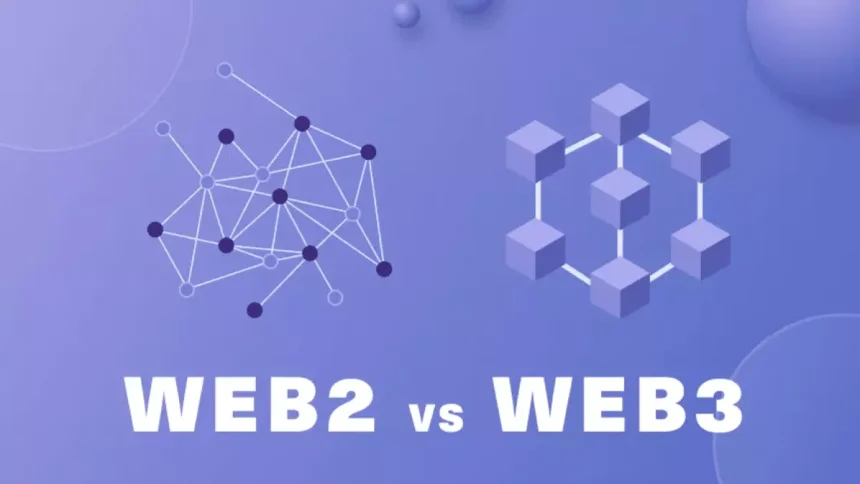
The internet has evolved from mostly static webpages into a highly interactive digital environment where people communicate, shop, work, create content, manage finances, and build online communities. The term Web2 generally describes this interactive, platform-driven era of the internet, while Web3 describes a proposed model that places greater emphasis on decentralization, blockchain-based applications, user-controlled digital assets, and programmable ownership.
- What Is Web2?
- What Is Web3?
- Web2 vs Web3 at a Glance
- The Biggest Difference: Who Controls the Infrastructure?
- Web2 vs Web3: Data Ownership
- Web2 vs Web3 Authentication
- Web2 vs Web3 Payments
- Web2 vs Web3: Smart Contracts
- Web2 vs Web3: Decentralized Applications
- Web2 vs Web3 and Digital Ownership
- Web2 vs Web3 and Decentralized Finance
- Web2 vs Web3 Security
- Web2 vs Web3 Privacy
- Web2 vs Web3 Scalability
- Web2 vs Web3 User Experience
- Web2 vs Web3 Business Models
- Web2 vs Web3 Adoption: What Do the Numbers Show?
- Is Web3 Actually Decentralized?
- Web2 vs Web3: Which Technology Should a Business Use?
- Web2 vs Web3 for Developers
- Web2 vs Web3 and the Future of the Internet
- Final Takeaway
- Frequently Asked Questions
- What is the main difference between Web2 and Web3?
- Is Web3 the same as blockchain?
- Is Web3 decentralized?
- Is Web3 more secure than Web2?
- What is a Web3 application?
- Do Web3 applications use normal websites?
- What is a smart contract in Web3?
- Does Web3 mean users own all their data?
- Are cryptocurrencies part of Web3?
- Is Web3 replacing Web2?
- Why are Web3 transactions sometimes expensive?
- Can a business use both Web2 and Web3?
- What skills are needed for Web3 development?
The difference between Web2 and Web3 is not simply that one uses blockchain and the other does not. The deeper distinction involves how applications are operated, where data and logic are stored, how users authenticate themselves, who controls digital infrastructure, and how value or ownership can be represented online.
In Web2, most applications rely on centralized companies and server infrastructure. A company typically controls the application, database, user accounts, and business rules. In Web3, some of those functions can move toward public blockchains, smart contracts, decentralized storage, and user-controlled wallets.
NIST’s 2025 report on Web3 describes it as a proposed restructuring of the internet toward a more user-centric model, with decentralized data, user-managed assets, distributed systems, digital tokens, and web-native currencies. NIST also emphasizes that Web3 introduces new security and privacy considerations rather than eliminating the risks associated with centralized systems.
This guide explains Web2 vs Web3 from a technical, practical, business, and user perspective, including architecture, ownership, privacy, security, applications, costs, scalability, digital identity, and real-world use cases.
What Is Web2?
Web2 is the term commonly used to describe the interactive and participatory phase of the internet that developed significantly from the early 2000s onward.
Unlike the mostly read-oriented websites associated with the earlier web, Web2 enabled users to create content, communicate in real time, collaborate online, and interact with sophisticated cloud-based applications.
Social networks, video platforms, online marketplaces, cloud productivity tools, SaaS applications, streaming platforms, online banking interfaces, and many modern websites operate using Web2-style architecture.
A typical Web2 application has a frontend that users interact with and a backend controlled by a company or organization. The backend may include application servers, databases, authentication systems, APIs, cloud infrastructure, analytics systems, and payment services.
For example, when someone creates an account on a conventional social media platform, the platform generally manages the account database and authentication process. When a user uploads a photograph, the platform’s infrastructure typically stores and processes that content.
This architecture has enabled enormous improvements in usability and scalability, but it also means that users generally depend on centralized providers.
What Is Web3?
Web3 is a proposed evolution of the internet that incorporates decentralized technologies such as blockchain networks, smart contracts, crypto wallets, tokens, decentralized applications, and decentralized storage.
NIST describes Web3 as a proposed vision in which ownership and operation are shifted toward users, changing the structure from an organization-centric model toward a more user-centric one.
Rather than relying exclusively on a company’s private database or server, a Web3 application may use a public blockchain to record transactions, ownership, permissions, or application state.
Smart contracts can provide application logic. Wallets can provide authentication and transaction signing. Tokens can represent digital assets or other rights. Decentralized storage can provide alternatives to storing every piece of application data on a single company’s servers.
Ethereum’s documentation describes decentralized applications, or dApps, as applications whose backend code operates on a decentralized network rather than exclusively on centralized servers.
However, Web3 should not be interpreted as meaning that every component of an application is decentralized. Many Web3 applications still use conventional web hosting, centralized APIs, cloud services, analytics providers, bridges, RPC providers, and other centralized infrastructure.
That distinction is important when evaluating whether an application is actually decentralized.
Web2 vs Web3 at a Glance
The simplest comparison looks like this:
| Feature | Web2 | Web3 |
| Architecture | Primarily client-server | Often combines blockchain and conventional infrastructure |
| Data control | Usually platform-controlled | May give users greater control over assets and some data |
| Authentication | Username, password, email, OAuth | Wallets, cryptographic signatures, and sometimes traditional login |
| Payments | Banks, cards, payment processors | Blockchain transactions, tokens, stablecoins, plus traditional payments |
| Ownership | Usually governed by platform databases and terms | Can be represented through blockchain-based assets and tokens |
| Application logic | Centralized servers | Can be implemented partly through smart contracts |
| Infrastructure | Cloud and centralized servers | Blockchain + decentralized and centralized infrastructure |
| Governance | Usually controlled by company or organization | May include community or protocol governance |
| Data portability | Often limited by platform | Can be improved for blockchain-based assets, but is not automatic |
| Transaction model | Platform/database updates | On-chain transactions for blockchain-controlled functions |
| Fees | Often subscription, advertising, transaction, or platform fees | Blockchain gas/network fees may apply |
| Security model | Account and server security | Wallet, key, smart-contract, protocol, and infrastructure security |
This table describes common architectural patterns rather than absolute rules. Web2 and Web3 are not binary categories where every application fits perfectly into one column.
The Biggest Difference: Who Controls the Infrastructure?
One of the most important Web2 vs Web3 differences is control.
In a traditional Web2 service, the company operating the application generally controls the servers, database, software, user accounts, and application policies.
For example, a centralized application can change its database, suspend accounts, modify its terms, remove content, change its business model, or shut down the service.
In Web3, some application rules can instead be implemented through smart contracts running on public blockchain networks.
Ethereum describes a smart contract as a program that resides at an address on the blockchain and executes functions when users or other contracts interact with it. Smart contracts can automatically enforce rules defined in their code.
That does not mean Web3 removes all forms of centralized control. The interface, development team, infrastructure provider, governance system, or administrative keys may still create centralized points of control.
Therefore, a better question than “Is this Web3?” is:
“Which parts of this application are decentralized, and who controls each component?”
Web2 vs Web3: Data Ownership
Data ownership is another major area of difference.
In many Web2 applications, user information is stored in centralized databases operated by companies. Users may have contractual rights to their data, but the underlying infrastructure remains controlled by the service provider.
The provider can determine how data is stored, processed, shared, displayed, or accessed according to its policies and applicable law.
Web3 attempts to change parts of this model by using public blockchains, cryptographic wallets, decentralized identifiers, and decentralized storage.
For example, ownership of a blockchain-based token can be represented by an on-chain address rather than solely by a company’s internal database record.
However, blockchain ownership does not automatically equal ownership of all associated information.
If a blockchain token points to an image, document, physical asset, or external database, the underlying asset may still depend on centralized infrastructure.
This is why the phrase “you own your data” should be treated carefully. Web3 can give users stronger control over certain digital assets and transactions, but it does not automatically decentralize every form of personal information.
Web2 vs Web3 Authentication
Traditional Web2 applications generally use account-based authentication.
A user might register with an email address and password or authenticate through another identity provider. The application maintains an account record that links the user’s identity to application data.
Web3 applications can use wallet-based authentication.
Instead of entering a password into the application, a user may connect a crypto wallet and sign a cryptographic message or transaction. Ethereum documentation identifies wallet-based authentication as part of its application stack.
This changes the security model.
In a conventional application, losing a password may be recoverable through email or another account recovery process.
With self-custodied blockchain assets, losing the private key or recovery phrase can result in permanent loss of access. Conversely, compromising a wallet can allow an attacker to authorize transactions without the need for a traditional password reset.
Web3 therefore changes the responsibility model rather than simply eliminating authentication problems.
Web2 vs Web3 Payments
Payments provide another clear distinction.
Web2 applications commonly rely on banks, card networks, payment processors, mobile payment systems, or platform-specific balances.
These systems are highly integrated with existing financial infrastructure and can provide familiar dispute, refund, fraud-monitoring, and account-recovery processes.
Web3 applications can use blockchain-based transactions and tokens.
A transaction may move digital assets directly between blockchain addresses without requiring a conventional payment processor to maintain the transaction ledger.
Stablecoins can also be used in blockchain applications to represent digital units designed to maintain a relatively stable value relative to another asset, commonly a fiat currency.
However, blockchain transactions can involve network fees, confirmation delays, wallet-management responsibilities, regulatory considerations, and irreversible transactions.
This means Web3 payments offer a different infrastructure model rather than a universally simpler payment experience.
Web2 vs Web3: Smart Contracts
Smart contracts are one of the defining technologies associated with Web3.
A smart contract is software deployed to a blockchain. On Ethereum, smart contracts can be publicly accessed and interacted with by other applications. Ethereum describes them as programmable components that can also be composed together like public APIs.
This composability is particularly important.
A developer can build one decentralized application that interacts with other smart contracts instead of creating every component from scratch.
For example, a decentralized finance application may interact with token contracts, lending protocols, decentralized exchanges, price oracles, and other blockchain components.
This creates a new application-development model in which protocols can function as reusable financial or computational building blocks.
For businesses, it also creates new technical requirements around contract auditing, testing, upgrade mechanisms, access control, transaction monitoring, and blockchain infrastructure.
Internal link opportunity: Your existing “Smart Contracts Explained: How They Work” article is a strong contextual link here. A service page for Smart Contract Development would also be relevant.
Web2 vs Web3: Decentralized Applications
A conventional Web2 application usually has its core backend hosted on centralized infrastructure.
A Web3 dApp can move some backend logic to blockchain-based smart contracts.
Ethereum explains that dApps can combine a frontend interface with smart contracts operating on a decentralized network.
A simplified architecture might look like:
User → Wallet → Web3 Frontend → Smart Contract → Blockchain
A more realistic application can be considerably more complex:
User → Wallet → Frontend → API/RPC Provider → Blockchain → Smart Contracts → Oracles/External Services
This distinction matters because the frontend itself may still be hosted on conventional cloud infrastructure.
Consequently, decentralization is often a spectrum rather than an on/off property.
Web2 vs Web3 and Digital Ownership
Digital ownership is one of the most frequently discussed Web3 concepts.
In Web2, a platform may maintain an internal record showing that a user has purchased, earned, or unlocked a particular digital item.
In Web3, ownership of certain digital assets can be represented directly on a blockchain.
NFTs are a common example. A blockchain can record which address currently controls a particular token.
This can potentially make digital assets transferable between compatible applications.
However, owning an NFT does not automatically grant copyright, trademark rights, commercial rights, or ownership of an underlying physical or intellectual property asset.
The legal rights associated with a token depend on the specific project, contractual terms, applicable law, and the nature of the underlying asset.
This distinction becomes particularly important for businesses exploring tokenization.
Internal link opportunity: A related article on “What Are RWA Tokens?” can explain how blockchain-based tokens can represent claims or interests connected to real-world assets.
Web2 vs Web3 and Decentralized Finance
Financial applications illustrate how Web3 architecture can change the design of online services.
Web2 financial applications typically operate through centralized institutions and databases. A bank, brokerage, payment provider, or fintech company manages the underlying accounts and transaction systems.
DeFi, or decentralized finance, uses blockchain networks and smart contracts to provide financial functions such as trading, lending, borrowing, and liquidity provision.
The important architectural distinction is that some financial rules can be executed by publicly accessible smart contracts rather than solely through an organization’s private backend.
This introduces new opportunities but also new risks.
Smart-contract vulnerabilities can expose users to financial losses. Ethereum’s security documentation notes that blockchain-based smart contracts can control substantial amounts of value and that vulnerabilities can be difficult to remediate because deployed code may be difficult or impossible to change.
Internal link opportunity: Link this section naturally to your existing “What Is DeFi? A Beginner’s Guide to Decentralized Finance.”
Web2 vs Web3 Security
Security is not simply a matter of saying that Web3 is safer or Web2 is safer. The threat models are different.
Web2 security commonly focuses on issues such as:
- Password theft
- Phishing
- Database breaches
- Session hijacking
- Server vulnerabilities
- API attacks
- Account takeover
- Insider access
Web3 introduces additional risks:
- Private-key compromise
- Seed-phrase theft
- Malicious wallet signatures
- Smart-contract vulnerabilities
- Oracle manipulation
- Bridge vulnerabilities
- Blockchain transaction errors
- Fake tokens and applications
- Protocol governance attacks
NIST’s 2025 Web3 security report specifically highlights security and privacy concerns associated with emerging decentralized technologies.
Smart-contract immutability can also make security mistakes particularly serious. Ethereum notes that vulnerabilities in deployed smart contracts can be difficult to repair and that assets lost through exploits may be difficult or impossible to recover.
Therefore, Web3 does not eliminate the need for cybersecurity. It changes the areas where security controls are required.
Web2 vs Web3 Privacy
Privacy presents a particularly interesting contrast.
Centralized Web platforms may collect extensive user information and maintain detailed profiles because data collection is often part of their business models.
Blockchain networks can reduce the need to disclose certain information for some transactions, but public blockchains can also create permanent and highly transparent transaction histories.
A blockchain address is not necessarily the same thing as an anonymous identity.
If an address becomes linked to a person’s real-world identity through an exchange, application, transaction pattern, or other data source, blockchain activity associated with that address may become easier to analyze.
Web privacy therefore requires careful consideration of wallet management, application architecture, transaction metadata, identity systems, and blockchain transparency.
Web2 vs Web3 Scalability
Scalability is another important difference.
Web2 applications can scale using established cloud computing techniques such as load balancing, caching, database replication, content delivery networks, and distributed server infrastructure.
Blockchain applications face additional constraints because transactions and state changes may need to be processed according to network consensus rules.
Ethereum’s development documentation identifies scaling as a major technical area and includes approaches such as rollups, zero-knowledge rollups, state channels, sidechains, and other scaling technologies.
Modern Web3 architecture increasingly uses multiple layers and supporting infrastructure rather than putting every operation directly on the base blockchain.
This means a practical Web3 application may combine blockchain settlement with conventional databases, off-chain computation, indexing services, and layer-2 networks.
Web2 vs Web3 User Experience
Web2 generally has an advantage in familiarity.
Users understand concepts such as:
“Create an account.”
“Enter password.”
“Reset password.”
“Pay with card.”
Web3 introduces concepts such as:
“Connect wallet.”
“Sign message.”
“Approve token.”
“Pay gas.”
“Confirm transaction.”
“Manage recovery phrase.”
These concepts can create additional friction for mainstream users.
For Web3 businesses, user experience therefore remains a major development consideration. A technically decentralized application can still fail to gain adoption if onboarding is confusing or security responsibilities are unclear.
Some applications combine Web2-style interfaces with Web3 infrastructure to reduce this friction.
This hybrid approach is increasingly relevant for businesses that want blockchain functionality without forcing users to understand every underlying technical component.
Web2 vs Web3 Business Models
Web2 business models commonly include advertising, subscriptions, transaction fees, SaaS licensing, marketplaces, and data-driven services.
Web3 can introduce additional models involving tokens, protocol fees, decentralized marketplaces, digital assets, blockchain-based financial applications, and tokenized real-world assets.
Tokenization is particularly relevant to businesses exploring new digital ownership and settlement systems.
However, issuing a token does not automatically create value. Businesses still need a legitimate use case, appropriate legal structure, security controls, user demand, sustainable economics, and reliable infrastructure.
Internal link opportunity: Your “Real-World Asset Tokenization Explained” article can support readers who want to understand how blockchain-based ownership can extend beyond purely digital assets.
Web2 vs Web3 Adoption: What Do the Numbers Show?
Web3 remains a developing technology category rather than a complete replacement for the existing internet.
One useful indicator of the size of the broader crypto ecosystem comes from a16z crypto’s 2025 State of Crypto report. The firm estimated approximately 40–70 million active crypto users, around 716 million people owning crypto, and approximately 181 million monthly active on-chain addresses. It also reported that total crypto market capitalization crossed $4 trillion in 2025. These figures use a methodology developed by a16z and should not be interpreted as a direct count of Web3 users because crypto ownership and Web3 application usage are not identical concepts.
The distinction is important for accurate SEO and business analysis.
A person holding cryptocurrency does not necessarily use decentralized applications. Similarly, someone interacting with a blockchain application may use a custodial wallet or centralized service without directly managing private keys.
Therefore, there is no single universally accepted number that represents “global Web3 users.”
Is Web3 Actually Decentralized?
This is one of the most important questions when comparing Web2 and Web3.
The answer depends on the specific application.
A Web3 application might have decentralized smart contracts but a centralized frontend.
Another might use a decentralized blockchain but rely on one company for wallet infrastructure or API access.
A project may also have blockchain-based governance while a small group retains substantial control through administrative keys or token ownership.
NIST’s Web3 research emphasizes the proposed decentralized and user-centric architecture while also discussing the security and privacy challenges that accompany these technologies.
For technical evaluation, consider each layer separately:
- Where is application logic executed?
- Who controls the smart contracts?
- Who controls upgrades?
- Where is user data stored?
- Who controls the frontend?
- What happens if the company disappears?
- Can users interact directly with the protocol?
- Are assets controlled by users or by a custodian?
- Are there administrative keys?
- Which components remain centralized?
This framework provides a more meaningful assessment than simply labeling a product “Web3.”
Web2 vs Web3: Which Technology Should a Business Use?
The appropriate architecture depends on the business problem.
A conventional Web2 architecture may be suitable when an application requires fast centralized data processing, straightforward account recovery, private databases, predictable infrastructure costs, and conventional payment systems.
Web3 may make more sense when a business needs blockchain-based settlement, transparent public records, user-controlled digital assets, tokenization, decentralized financial functionality, or smart-contract automation.
Hybrid architecture may be appropriate when businesses need both.
For example, a business could keep customer profiles and application analytics in conventional infrastructure while using a blockchain for ownership records or settlement.
The important question is not whether a business should “move to Web3” simply because the technology exists.
The better technical question is:
“Which specific component of the business benefits from blockchain-based infrastructure, and what trade-offs does that introduce?”
Web2 vs Web3 for Developers
For developers, the difference is especially significant at the backend and infrastructure layers.
Web2 developers commonly work with databases, APIs, cloud infrastructure, authentication systems, backend frameworks, and centralized application servers.
Web3 developers may additionally need knowledge of:
- Smart contracts
- Blockchain networks
- Wallet integration
- Cryptographic signatures
- Token standards
- Gas and transaction fees
- Oracles
- Blockchain indexing
- Layer-2 networks
- Smart-contract testing
- Security auditing
Ethereum’s current developer documentation covers smart contracts, dApps, wallets and accounts, transactions, nodes, consensus, storage, authentication, scaling, oracles, and other components of the Web3 development stack.
Smart-contract development also introduces a different deployment model. Once deployed, smart contracts may be difficult to modify, which makes testing and security review especially important.
Internal service-page opportunities include:
- Blockchain Development
- Web3 Development
- dApp Development
- Smart Contract Development
- DeFi Development
- Crypto Wallet Development
- Token Development
- NFT Development
- Blockchain Consulting
- RWA Tokenization Development
These should link only to actual service pages available on the website.
Web2 vs Web3 and the Future of the Internet
Web3 is better understood as an evolving architectural approach than as a finished replacement for Web2.
Many applications are likely to continue using centralized infrastructure because centralized systems can be efficient for particular tasks.
At the same time, blockchain infrastructure can provide useful capabilities for digital ownership, settlement, tokenization, programmable transactions, decentralized financial applications, and cross-organization coordination.
The most realistic future may therefore involve greater integration between conventional internet architecture and blockchain networks rather than a complete transition from Web2 to Web3.
Hybrid applications can use Web2 infrastructure for user experience and high-volume data processing while using blockchain networks for ownership, verification, settlement, or programmable agreements.
This model also allows businesses to adopt blockchain where it provides a measurable technical or commercial benefit rather than treating decentralization as an objective by itself.
Final Takeaway
Web2 and Web3 represent different approaches to building and operating internet applications.
Web2 is primarily characterized by centralized platforms, company-controlled infrastructure, conventional accounts, cloud services, and database-driven applications. This architecture supports the majority of the services people use online today.
Web3 proposes a more decentralized architecture in which blockchains, smart contracts, wallets, tokens, and decentralized applications can move selected functions away from centralized platforms and toward public networks and user-controlled systems.
The most meaningful difference is therefore not simply “centralized versus decentralized.” It is about where application logic lives, who controls digital assets, how identity works, where data is stored, how transactions are processed, and which infrastructure participants users must trust.
Current Web3 adoption demonstrates significant activity across crypto wallets, blockchain addresses, decentralized applications, tokenization, and financial protocols, but the available industry statistics do not represent a single standardized measurement of global Web3 adoption. a16z’s 2025 estimates illustrate the scale of the broader crypto ecosystem while also showing why crypto ownership, active users, and on-chain activity should be treated as different metrics.
For businesses and developers, the practical question is not whether Web2 or Web3 is universally appropriate. It is which architecture solves a particular problem effectively while accounting for security, privacy, scalability, usability, regulatory, infrastructure, and operational requirements.
Web3 is continuing to evolve, and its long-term role in the internet will depend not only on blockchain technology itself but also on whether decentralized systems can provide useful applications, reliable security, accessible user experiences, and sustainable infrastructure.
Frequently Asked Questions
What is the main difference between Web2 and Web3?
Web2 generally relies on centralized platforms and infrastructure controlled by companies, while Web3 is a proposed model that uses technologies such as blockchains, smart contracts, wallets, tokens, and decentralized applications to distribute certain forms of control and ownership.
Is Web3 the same as blockchain?
No. Blockchain is one of the foundational technologies used in many Web3 applications, but Web3 is a broader concept involving decentralized applications, digital assets, user-controlled identity, decentralized storage, blockchain networks, and other technologies.
Is Web3 decentralized?
Web applications can be decentralized to different degrees. Some use decentralized smart contracts while retaining centralized interfaces, infrastructure, or administrative controls. Decentralization should therefore be evaluated component by component.
Is Web3 more secure than Web2?
Neither model can universally be described as more secure. Web2 and Web3 have different threat models. Web3 introduces additional risks involving private keys, smart contracts, blockchain transactions, oracles, and wallet security. NIST specifically identifies security and privacy considerations associated with Web3 technologies.
What is a Web3 application?
A Web3 application, often called a dApp, typically combines a user interface with blockchain-based smart contracts or other decentralized infrastructure. Ethereum describes dApps as applications whose backend logic can run on decentralized networks.
Do Web3 applications use normal websites?
Yes. A Web3 application can have a conventional web-based frontend. The difference is that some application functions may interact with blockchain networks or smart contracts rather than relying exclusively on centralized backend infrastructure.
What is a smart contract in Web3?
A smart contract is software deployed on a blockchain that executes programmed functions when triggered by transactions or other blockchain events. On Ethereum, smart contracts can be publicly accessed and composed with other contracts.
Does Web3 mean users own all their data?
No. Web3 can give users greater control over certain digital assets and blockchain accounts, but many Web3 applications still rely on centralized databases, cloud services, APIs, or storage systems. Blockchain-based ownership should not automatically be interpreted as complete ownership of all associated personal data.
Are cryptocurrencies part of Web3?
Cryptocurrencies can be part of the Web3 ecosystem, particularly where blockchain-based payments or digital assets are involved. However, cryptocurrency ownership is not synonymous with Web3 usage.
Is Web3 replacing Web2?
There is no universal replacement point. Web2 and Web3 technologies can coexist, and many modern applications use hybrid architectures combining centralized infrastructure with blockchain components.
Why are Web3 transactions sometimes expensive?
Blockchain transactions consume network resources. Networks may charge transaction or gas fees to process state changes and smart-contract interactions. Ethereum’s documentation specifically describes gas as the computational resource associated with processing transactions.
Can a business use both Web2 and Web3?
Yes. A business can use conventional web infrastructure for databases, application interfaces, authentication, and high-volume processing while using blockchain technology for selected functions such as tokenization, settlement, digital ownership, or smart-contract automation.
What skills are needed for Web3 development?
Web3 development can require conventional frontend and backend development skills alongside blockchain concepts, smart contracts, wallets, cryptographic signatures, token standards, blockchain infrastructure, transaction handling, and smart-contract security.
If you want to contribute your piece of content on Crypto, Bitcoins and other digital currencies for Bitsoz, You can search for us in Google with queries like “write for us crypto”. “Write for us bitcoins” or directly contact us and let us know what you want.