

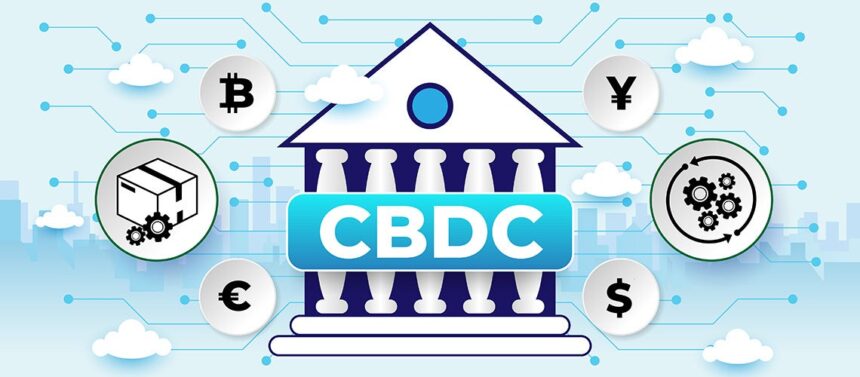
A central bank digital currency (CBDC) is a digital form of a country’s official currency issued by its central bank. Unlike Bitcoin or other cryptocurrencies, a CBDC is not a privately created digital asset. It represents a direct form of central bank money and is designed to function as a digital payment instrument or settlement asset.
- What Does CBDC Stand For?
- How Does a CBDC Work?
- Retail CBDC vs. Wholesale CBDC
- CBDC vs. Cryptocurrency: What Is the Difference?
- CBDC vs. Stablecoins
- Why Are Central Banks Exploring CBDCs?
- Declining Use of Physical Cash
- Faster and More Efficient Payments
- Financial Inclusion
- Cross-Border Payments
- Monetary Sovereignty
- What Are the Potential Benefits of CBDCs?
- What Are the Risks of CBDCs?
- Does a CBDC Need Blockchain?
- Can CBDCs Be Programmable?
- Are CBDCs Already Available?
- What Is Happening With the Digital Euro?
- What About CBDCs in the United States?
- CBDCs and the Future of Money
- CBDC and Cryptocurrency Regulation
- How to Build a CBDC Topic Cluster
- What the Future of CBDCs Could Look Like
- Final Thoughts: Why CBDCs Matter
- Frequently Asked Questions About CBDCs
- What is a CBDC in simple terms?
- Is CBDC the same as cryptocurrency?
- Is CBDC the same as a stablecoin?
- Does a CBDC use blockchain?
- What is the difference between retail and wholesale CBDC?
- How many countries are exploring CBDCs?
- How many central banks are researching CBDCs?
- Have any countries launched a CBDC?
- What are the main benefits of CBDCs?
- What are the main risks of CBDCs?
- Can CBDCs replace cash?
- Can CBDCs affect commercial banks?
- What is the digital euro?
- Will every country have a CBDC?
- Are CBDCs good or bad?
- Are CBDCs the future of money?
- Should businesses prepare for CBDCs?
- Medical, Financial and Regulatory Disclaimer
The idea has moved from a theoretical discussion about the future of money to an active area of monetary and financial policy. Central banks around the world are researching, testing, piloting, and in some cases launching CBDCs for retail consumers, businesses, financial institutions, or cross-border transactions.
The scale of this global activity is significant. The Atlantic Council’s CBDC Tracker reported in May 2026 that 146 countries and currency unions, representing more than 98% of global GDP, were exploring a CBDC. It identified 77 jurisdictions in an advanced stage of exploration, including development, pilot programs or launches, and 41 CBDC pilot projects worldwide.
The Bank for International Settlements (BIS) provides another important measure. Its 2024 survey, published in August 2025, found that 85 of 93 surveyed central banks, or 91%, were exploring retail CBDCs, wholesale CBDCs, or both.
These numbers show why understanding central bank digital currency matters. CBDCs could influence how consumers pay, how banks settle transactions, how governments distribute funds, how cross-border payments operate, and how central banks maintain the role of public money as cash usage declines and private digital payment systems expand.
What Does CBDC Stand For?
CBDC stands for Central Bank Digital Currency.
Breaking down the term makes the concept easier to understand:
“Central bank” means the currency is issued or backed by a country’s monetary authority.
“Digital” means the currency exists in electronic form rather than as physical banknotes or coins.
“Currency” means it is intended to represent the country’s official unit of money, such as the dollar, euro, pound, rupee or another sovereign currency.
A CBDC is therefore best understood as digital central bank money rather than simply “another cryptocurrency.”
That distinction is fundamental to understanding the technology.
How Does a CBDC Work?
A CBDC system can be designed in different ways, so there is no single global CBDC architecture.
A typical retail CBDC could involve the central bank providing the underlying monetary infrastructure while commercial banks and payment providers handle customer-facing services.
For example, imagine a consumer using a digital wallet to pay a merchant. The consumer’s CBDC wallet could contain digital units representing the country’s official currency. When the payment is made, the CBDC system records the transfer and enables the merchant to receive the corresponding digital money.
The central bank does not necessarily need to provide every customer service directly.
A two-tier or intermediated model can allow commercial banks and regulated payment service providers to handle functions such as onboarding, wallets, customer support and payment interfaces while the central bank maintains responsibility for the underlying central bank money.
This distinction matters because one of the major questions surrounding CBDCs is whether central banks should become direct providers of retail financial services or whether existing financial institutions should remain involved.
The BIS has emphasized that CBDCs are part of a broader transformation of the financial system in which central bank money, commercial bank money and tokenized assets may become more interconnected.
Retail CBDC vs. Wholesale CBDC
One of the most important CBDC concepts is the difference between retail and wholesale digital currencies.
What Is a Retail CBDC?
A retail CBDC is designed for use by individuals and businesses.
It could potentially be used for:
- Everyday purchases
- Person-to-person payments
- Online transactions
- Government payments
- Merchant payments
- Transfers between individuals
- Offline payments in some designs
In simple terms, retail CBDC is intended to function more like digital cash for the general public.
However, it does not necessarily mean everyone would have a direct account with the central bank. The exact arrangement depends on the country’s chosen design.
What Is a Wholesale CBDC?
A wholesale CBDC is primarily designed for financial institutions and other eligible participants.
It can be used for:
- Interbank settlement
- Securities settlement
- Cross-border transactions
- Tokenized asset settlement
- Central bank operations
- Financial market infrastructure
Wholesale CBDCs are particularly interesting because they could potentially make large-value financial transactions faster and more programmable.
According to the BIS 2024 survey, wholesale CBDC exploration was generally at a more advanced stage than retail CBDC exploration.
This is an important distinction for anyone researching “CBDC meaning,” because a CBDC project discussed in financial-market news may have nothing to do with a digital wallet for ordinary consumers.
CBDC vs. Cryptocurrency: What Is the Difference?
CBDCs and cryptocurrencies are both digital, but they are fundamentally different forms of money or assets.
A cryptocurrency such as Bitcoin operates on a decentralized network and is not issued by a central bank.
A CBDC, by contrast, is sovereign money issued by a central bank.
Bitcoin’s supply rules, network governance and transaction validation operate through its underlying protocol and decentralized participants. A CBDC operates within a country’s legal and institutional monetary framework.
This creates major differences in:
| Feature | CBDC | Cryptocurrency |
| Issuer | Central bank | Usually decentralized network or private project |
| Legal/monetary status | Sovereign currency framework | Depends on asset and jurisdiction |
| Price stability | Generally intended to maintain currency value | Often highly volatile |
| Monetary authority | Central bank | Network/protocol governance |
| Main purpose | Digital form of public money | Varies by cryptoasset |
| Blockchain required? | No | Depends on cryptocurrency |
| Transaction model | Centralized, intermediated or distributed depending on design | Varies significantly |
| Consumer protection | Determined by legal and regulatory framework | Varies widely |
The phrase “digital currency” can therefore be misleading. Digital money already exists in many forms through bank accounts, card payments and electronic transfers.
The key difference is who ultimately issues the money and what type of claim it represents.
CBDC vs. Stablecoins
CBDCs are also different from stablecoins.
A stablecoin is generally a privately issued digital token designed to maintain a relatively stable value against a reference asset, often a national currency.
A CBDC is central bank money.
A stablecoin may depend on reserves, collateral, governance structures and the credibility of its issuer to maintain its value. A CBDC represents a direct form of central bank money under the relevant legal and monetary framework.
This distinction is becoming increasingly important because central banks are evaluating CBDCs alongside developments in stablecoins and tokenized financial assets.
The BIS reported that more than one-third of jurisdictions surveyed in its 2024 study had accelerated CBDC work partly because of developments involving stablecoins and other cryptoassets.
For financial websites, this creates a useful content cluster around CBDCs, stablecoins, tokenization, digital payments and cryptocurrency regulation.
Why Are Central Banks Exploring CBDCs?
There is no single reason every central bank is exploring a digital currency.
Different countries have different payment systems, economic structures, levels of financial inclusion and policy priorities.
However, several motivations appear repeatedly.
Declining Use of Physical Cash
As consumers increasingly use cards, mobile wallets and online payments, cash can become less central to everyday transactions.
Central banks are therefore considering whether the public should continue to have access to a form of central bank money in an increasingly digital economy.
The BIS found that preserving the role of central bank money as cash declines and tokenization expands is an important motivation behind CBDC work.
Faster and More Efficient Payments
CBDCs could potentially improve payment efficiency by creating standardized digital infrastructure.
The exact benefit would depend on how the system is designed and integrated with existing payment networks.
A CBDC does not automatically make payments instant, cheap or efficient. Technology, regulation, interoperability and adoption all matter.
Financial Inclusion
In some economies, CBDCs are being investigated as a way to improve access to digital payments and financial services.
This is particularly relevant where large sections of the population are underbanked or where payment infrastructure is uneven.
However, simply launching a CBDC does not guarantee financial inclusion. Users still need access to devices, connectivity, identification systems, appropriate interfaces and reliable payment infrastructure.
Cross-Border Payments
International payments can involve multiple intermediaries, currencies, compliance processes and settlement systems.
CBDCs could potentially support more efficient cross-border transactions if countries establish compatible infrastructure and regulatory arrangements.
This is one reason wholesale CBDCs have attracted substantial attention from central banks.
Monetary Sovereignty
Central banks are also considering how privately issued digital money, foreign digital currencies and stablecoins could influence domestic payment systems.
A widely adopted foreign or privately issued digital currency could potentially change the role of national money.
CBDCs are partly a response to this broader transformation of the monetary system.
What Are the Potential Benefits of CBDCs?
CBDCs are frequently discussed as a way to modernize money, but their potential advantages depend heavily on design.
One potential benefit is payment efficiency. A well-designed CBDC could enable standardized digital transactions and potentially reduce some forms of payment friction.
Another is settlement efficiency. Wholesale CBDCs could potentially allow financial institutions to settle transactions involving tokenized securities and other digital assets using central bank money.
CBDCs may also improve interoperability between different payment systems if technical standards are designed accordingly.
Another possible benefit is resilience. A CBDC system could provide an additional payment infrastructure rather than relying entirely on privately operated systems.
Offline functionality is another area of research. BIS surveys have found that offline payment capabilities are among the design features being considered by central banks for retail CBDCs.
CBDCs could also potentially support government-to-person payments. In theory, governments could use digital public money to distribute certain payments more efficiently, although the exact design and legal framework would determine how this could work.
What Are the Risks of CBDCs?
The case for CBDCs is not simply about technological improvement.
CBDCs create significant policy questions, particularly around privacy, financial stability, cybersecurity, monetary policy and the role of commercial banks.
Privacy Concerns
Privacy is one of the most frequently discussed CBDC issues.
Digital payments can generate information about transactions, and the design of a CBDC determines who can access that information and under what circumstances.
A CBDC does not inherently require the government to see every transaction in real time. Privacy can be incorporated into the technical and legal architecture.
However, the precise level of privacy must be established through legislation, regulation and system design.
This is why statements that CBDCs are automatically either “completely anonymous” or “government surveillance money” are overly simplistic.
The reality depends on the jurisdiction and the design.
Financial Stability
One of the most important economic concerns is whether people could move large amounts of money from commercial bank deposits into CBDC during periods of financial stress.
Commercial banks rely heavily on deposits as a source of funding for lending.
If CBDCs became highly attractive relative to bank deposits, a crisis could potentially accelerate movement into central bank money.
The IMF identifies several financial-stability transmission channels, including bank funding and lending, fee income, bank-run risk, information flows and payment-system resilience.
This is why CBDC designs may include safeguards such as holding limits, tiered remuneration or other mechanisms.
The BIS reported that more than half of central banks surveyed were considering holding limits for retail CBDCs.
Cybersecurity
A national digital currency would become critical financial infrastructure.
That makes cybersecurity extremely important.
A successful CBDC system would need strong protection against hacking, fraud, operational failures, denial-of-service attacks and other threats.
The larger the adoption of a CBDC, the greater the importance of resilience and recovery mechanisms.
Technology and Operational Risk
A CBDC is not simply an app.
It requires infrastructure capable of processing potentially enormous numbers of transactions while maintaining availability, security and accuracy.
Central banks also need to consider upgrades, interoperability, offline functionality, identity verification and integration with existing banking and payment systems.
A technically impressive system can still fail if consumers and merchants find it difficult to use.
Does a CBDC Need Blockchain?
No.
A central bank digital currency does not have to use blockchain technology.
Distributed ledger technology may be considered in some CBDC projects, but central banks can also use conventional centralized databases or other technological architectures.
This is an important distinction because CBDC and blockchain are not synonymous.
The purpose of a CBDC is to create a digital form of central bank money. The underlying technical architecture is a separate design decision.
Some CBDC systems may use distributed ledger technology, while others may not.
The BIS has highlighted tokenization and unified-ledger approaches as broader areas of financial innovation rather than suggesting that every CBDC must use one specific technology.
Can CBDCs Be Programmable?
Programmability is another frequently misunderstood CBDC concept.
A programmable payment could include conditions that determine when or how a transaction is executed.
For example, a payment could potentially be released automatically after a predefined condition is met.
However, there is an important distinction between programmable money and programmable transactions.
The IMF’s CBDC work notes that CBDC-related programmability can be used to automate certain compliance or capital-flow processes while maintaining the fungibility of money itself.
This distinction matters because claims that central banks will necessarily create money that can only be spent on specific products are not a universal feature of CBDCs.
Whether such functionality exists, and how it operates, depends on the system’s legal and technical design.
Are CBDCs Already Available?
Yes, but CBDC adoption varies significantly by country.
According to the Atlantic Council’s May 2026 tracker, three countries had fully launched retail CBDCs: The Bahamas, Jamaica and Nigeria. It also identified 41 CBDC pilot projects worldwide.
This demonstrates the difference between “exploring a CBDC” and “having a CBDC.”
A country can be:
- Researching the concept.
- Developing a technical prototype.
- Running a limited pilot.
- Conducting a larger pilot.
- Preparing legal and operational infrastructure.
- Launching a CBDC nationally.
Therefore, headlines stating that a country is “creating a digital currency” should always be interpreted in context.
What Is Happening With the Digital Euro?
The digital euro is one of the world’s most closely watched CBDC projects.
The European Central Bank completed its preparation phase in October 2025 after beginning that phase in November 2023. The ECB then moved to the next stage of technical preparation.
As of 2026, the project is still dependent on the relevant European legislative process.
The ECB has stated that, assuming legislation is adopted in the course of 2026, it aims to be ready for potential first issuance during 2029. A pilot exercise could begin earlier, with the ECB’s current pilot plans pointing toward an operational phase beginning in the second half of 2027 and lasting 12 months.
This is a useful example of why CBDC content needs careful wording. A digital euro is not simply “already launched.” It remains a project progressing through technical, legislative and pilot stages.
What About CBDCs in the United States?
The United States has taken a different approach from some jurisdictions.
Rather than assuming that a retail U.S. CBDC is inevitable, the Federal Reserve has repeatedly emphasized that it has not made a decision to issue one and that authorization from the executive branch and Congress would be necessary.
This makes the U.S. case particularly important when discussing global CBDC development.
A country can have extensive research and experimentation around digital money without committing to a national retail CBDC.
The U.S. discussion also illustrates an important distinction between central bank research, wholesale settlement innovation and a retail digital dollar used by the general public.
CBDCs and the Future of Money
CBDCs should not be viewed in isolation.
The financial system is simultaneously experiencing several transformations:
- Instant payment systems
- Stablecoins
- Tokenized deposits
- Tokenized securities
- Digital wallets
- Blockchain-based settlement
- Artificial intelligence in financial services
- Cross-border payment modernization
- Open banking
- Central bank digital currencies
These technologies can overlap.
For example, a future financial market could potentially use tokenized securities, commercial-bank digital money and wholesale CBDC infrastructure within the same transaction.
This is one reason the BIS increasingly discusses CBDCs alongside tokenization and unified financial-market infrastructure.
The future of money is therefore unlikely to be a simple competition between “cash versus CBDC” or “CBDC versus Bitcoin.”
Instead, multiple forms of money and settlement assets may coexist.
CBDC and Cryptocurrency Regulation
CBDCs also need to be distinguished from crypto regulation.
A CBDC is created within the country’s existing monetary and legal framework.
Cryptocurrency regulation generally concerns privately issued or decentralized digital assets, exchanges, stablecoins, custodians and related services.
This creates opportunities for financial websites to build a broader topical cluster around:
- Cryptocurrency regulation
- Stablecoin regulation
- Digital asset laws
- Tokenization
- CBDC policy
- Blockchain regulation
- Crypto taxation
- Digital payments
- Central bank monetary policy
For a website offering financial consulting, fintech advisory or blockchain services, these subjects can support both informational SEO and commercial-intent pages.
How to Build a CBDC Topic Cluster
A strong CBDC content cluster could use this article as the main pillar.
Supporting pages could cover:
- What Is a CBDC?
- CBDC vs Cryptocurrency
- CBDC vs Stablecoins
- Retail CBDC vs Wholesale CBDC
- CBDC Benefits and Risks
- How CBDCs Affect Commercial Banks
- CBDCs and Financial Privacy
- CBDCs and Monetary Policy
- Digital Euro Explained
- Digital Dollar Explained
- CBDCs and Cross-Border Payments
- CBDCs and Blockchain Technology
- CBDCs and Tokenized Assets
- CBDC Regulation Around the World
Each supporting article should link back to the main CBDC guide.
The pillar page should then link outward to the deeper articles.
This creates a hub-and-spoke structure that helps search engines understand the site’s topical coverage while giving readers a logical path to more specific information.
What the Future of CBDCs Could Look Like
The future remains uncertain.
Some countries may launch retail CBDCs at scale. Others may decide that existing instant payment systems and commercial-bank digital money provide sufficient functionality.
Wholesale CBDCs may become more prominent because financial-market settlement presents different challenges from everyday consumer payments.
The BIS’s 2024 survey already found that wholesale CBDC work was generally further advanced than retail CBDC work.
The future could also involve combinations of CBDCs with tokenized deposits, stablecoins, instant payment systems and tokenized securities.
Rather than one technology replacing every existing form of money, the financial system may evolve toward greater interoperability between different forms of digital money.
The central question is therefore not simply whether CBDCs will “win.”
It is whether central banks can design digital public money that provides meaningful benefits while preserving financial stability, privacy, security, competition and public trust.
Final Thoughts: Why CBDCs Matter
A central bank digital currency is more than a digital version of a banknote.
It represents a potential change in how central bank money interacts with consumers, commercial banks, payment providers and financial markets.
The global scale of experimentation demonstrates the importance of the subject. The BIS found that 91% of surveyed central banks were exploring retail or wholesale CBDCs in its 2024 survey, while the Atlantic Council’s 2026 tracker identified 146 countries and currency unions exploring CBDCs.
But exploration does not equal adoption.
Some CBDCs are in research. Some are in development. Some are being piloted. A small number have launched.
The technology also does not automatically determine the outcome. Legal rules, privacy protections, monetary policy, banking structures, cybersecurity, interoperability and consumer adoption will all influence whether CBDCs succeed.
For consumers and businesses, the most useful approach is therefore to understand the distinction between CBDCs, cryptocurrencies, stablecoins, bank deposits and other forms of digital money.
As the financial system becomes increasingly digital, that distinction will become more important—not less.
Frequently Asked Questions About CBDCs
What is a CBDC in simple terms?
A CBDC is a digital form of a country’s official currency issued by its central bank. It is intended to represent central bank money in digital form and can be designed for consumers, businesses, financial institutions or multiple user groups.
Is CBDC the same as cryptocurrency?
No. A CBDC is issued by a central bank and represents sovereign money, while cryptocurrencies such as Bitcoin generally operate on decentralized networks and are not issued by central banks.
Is CBDC the same as a stablecoin?
No. A stablecoin is generally a privately issued digital token designed to maintain a stable value against an asset such as a national currency. A CBDC is central bank money.
Does a CBDC use blockchain?
Not necessarily. A CBDC can use distributed ledger technology, but blockchain is not a mandatory requirement for creating a central bank digital currency.
What is the difference between retail and wholesale CBDC?
A retail CBDC is designed for individuals and businesses, while a wholesale CBDC is primarily intended for financial institutions and financial-market settlement.
How many countries are exploring CBDCs?
The Atlantic Council’s CBDC Tracker reported in May 2026 that 146 countries and currency unions, representing more than 98% of global GDP, were exploring a CBDC.
How many central banks are researching CBDCs?
The BIS’s 2024 survey found that 85 of 93 surveyed central banks, equivalent to 91%, were exploring retail CBDCs, wholesale CBDCs or both.
Have any countries launched a CBDC?
Yes. The Atlantic Council reported in May 2026 that The Bahamas, Jamaica and Nigeria had fully launched retail CBDCs.
What are the main benefits of CBDCs?
Potential benefits include more efficient digital payments, improved settlement, greater access to central bank money in a digital economy, possible financial inclusion benefits and potential improvements to cross-border payment infrastructure.
What are the main risks of CBDCs?
Major concerns include privacy, cybersecurity, operational resilience, financial stability, bank funding, potential movement of deposits into CBDCs during periods of stress and questions about governance and monetary policy.
Can CBDCs replace cash?
It is possible that some countries could eventually reduce their dependence on cash, but CBDC development does not automatically mean that physical cash will disappear. Whether cash remains available depends on national policy, consumer demand and legislation.
Can CBDCs affect commercial banks?
Yes. Depending on their design and adoption, CBDCs could influence bank deposits, funding, lending and payment services. The IMF identifies bank funding, lending, fee income and run risk among the financial-stability channels that policymakers need to evaluate.
What is the digital euro?
The digital euro is the European Central Bank’s proposed form of digital central bank money for the euro area. The ECB completed its preparation phase in 2025 and is continuing technical and legislative preparations. Subject to legislation, the ECB has stated that it aims to be ready for potential first issuance during 2029.
Will every country have a CBDC?
Not necessarily. Central banks are assessing CBDCs according to their own economic, technological, legal and monetary circumstances. Some may launch one, while others may decide existing payment infrastructure is sufficient.
Are CBDCs good or bad?
There is no universal answer. A CBDC’s impact depends on its design, adoption, legal framework and safeguards. The potential benefits must be weighed against privacy, financial stability, cybersecurity and other risks.
Are CBDCs the future of money?
CBDCs could become an important component of future financial infrastructure, but they are unlikely to be the only form of digital money. Commercial bank deposits, stablecoins, instant payments, tokenized assets and potentially CBDCs may coexist and interact within the future financial system.
Should businesses prepare for CBDCs?
Businesses operating in payments, banking, fintech, cryptocurrency, blockchain, compliance or financial infrastructure should monitor CBDC developments because changes in payment and settlement infrastructure could create both opportunities and regulatory requirements. The appropriate preparation depends on the business model and jurisdiction.
Medical, Financial and Regulatory Disclaimer
This article is intended for educational and informational purposes and does not constitute investment, legal, regulatory, banking or financial advice. CBDC policies, legislation, pilot programs and regulatory frameworks can change. Businesses and individuals should consult qualified professionals and official authorities before making decisions based on CBDC developments.
If you want to contribute your piece of content on Crypto, Bitcoins and other digital currencies for Bitsoz, You can search for us in Google with queries like “write for us crypto”. “Write for us bitcoins” or directly contact us and let us know what you want.