

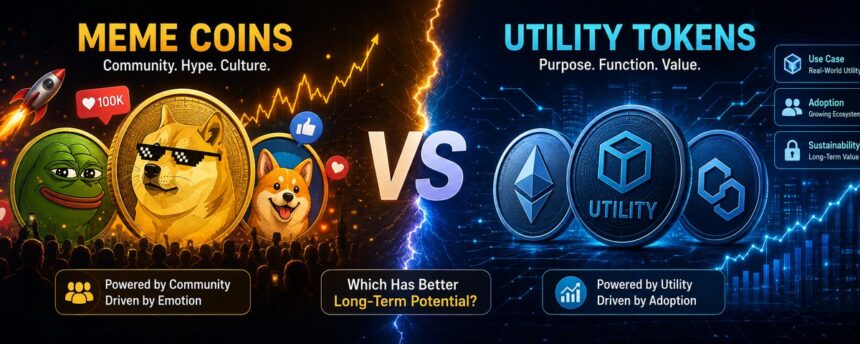
Meme coins and utility tokens represent two very different approaches to value in the cryptocurrency market.
- What Is a Meme Coin?
- What Is a Utility Token?
- Meme Coins vs Utility Tokens: The Core Difference
- Why Meme Coins Can Have Long-Term Potential
- Community can become an economic asset
- Social attention has measurable market effects
- Meme coins can develop brand persistence
- Why Utility Tokens May Have a Stronger Fundamental Foundation
- Utility Does Not Automatically Mean Long-Term Value
- Tokenomics Can Determine Which Model Wins
- Market Capitalization Matters More Than Token Price
- Liquidity Is a Critical Advantage for Meme Coins
- Network Effects: The Biggest Similarity Between the Two
- Meme Coins Have an Attention-Retention Problem
- Can a Meme Coin Become a Utility Token?
- Regulatory Considerations Matter
- Which Has Better Long-Term Potential?
- A Practical Framework for Comparing a Meme Coin and Utility Token
- A Long-Term Potential Scorecard
- Red Flags to Watch for in Meme Coins
- Red Flags to Watch for in Utility Tokens
- The Hybrid Model May Ultimately Be the Most Powerful
- Final Verdict: Meme Coins vs Utility Tokens
- FAQs: Meme Coins vs Utility Tokens
- Are utility tokens better than meme coins for long-term investment?
- Can meme coins have long-term value?
- What gives a utility token value?
- Are meme coins riskier than utility tokens?
- Do utility tokens always have real utility?
- Why are meme coins so volatile?
- Can a meme coin become a utility token?
- What is more important: token price or market cap?
- What should I check before buying a meme coin?
- What should I check before buying a utility token?
- Are utility tokens regulated?
- Are meme coins securities?
- Can a utility token lose all its value?
- Should beginners invest in meme coins or utility tokens?
- Which has greater upside: meme coins or utility tokens?
- What is the biggest difference between meme coins and utility tokens?
Meme coins typically gain attention through internet culture, communities, social media, narratives, and speculation. Utility tokens, by contrast, are designed to provide access to a product, platform, service, protocol, governance mechanism, or other blockchain-based function.
That distinction creates an important question for long-term crypto investors: which type has better potential over the next several years?
The short answer is that utility tokens generally have a stronger fundamental framework for long-term value because their demand can be connected to actual usage. But that does not mean every utility token will succeed, and it does not mean meme coins cannot produce enormous returns. A meme coin can develop powerful network effects, brand recognition, liquidity, and community loyalty that become valuable in their own right.
The real issue is what supports the token’s value after the initial excitement disappears.
Current market data illustrates why the comparison matters. CoinGecko’s cryptocurrency category data currently places the total meme-coin sector at roughly $33.5 billion, with approximately $3.31 billion in 24-hour trading volume. The broader crypto market is measured in trillions of dollars, showing that meme coins are a meaningful but relatively small segment of the overall digital-asset economy.
Meanwhile, utility-oriented blockchain ecosystems can generate demand from decentralized finance, gaming, decentralized applications, infrastructure, payments, governance, data, storage, and other on-chain activities.
This article examines the fundamental differences between meme coins and utility tokens, their sources of value, risk profiles, tokenomics, adoption potential, network effects, regulatory considerations, and the factors that may determine their long-term performance.
Important note: This article is educational information, not personalized financial advice. Cryptocurrency assets can lose substantial or all of their value, and the classification and regulatory treatment of individual tokens can vary by jurisdiction and by how they are issued and sold.
What Is a Meme Coin?
A meme coin is a crypto asset whose identity and demand are heavily influenced by an internet meme, cultural reference, online community, personality, trend, or social narrative.
Dogecoin is the classic example, while later projects such as Shiba Inu, PEPE, BONK, dogwifhat, FLOKI, and other community-driven tokens have demonstrated how quickly internet culture can translate into market value.
The U.S. Securities and Exchange Commission’s Division of Corporation Finance described meme coins in its February 2025 staff statement as crypto assets inspired by internet memes, characters, current events, or trends. The statement said these assets are typically purchased for entertainment, social interaction, and cultural purposes, with value driven primarily by market demand and speculation. It also noted that they typically have limited or no functionality.
That definition is useful because it highlights the economic foundation of many meme coins: attention.
A meme coin may not need sophisticated technology to become popular. Instead, it may benefit from:
- Strong community participation
- Viral social media activity
- Exchange listings
- Influencer attention
- Cultural relevance
- Scarcity or token-burning narratives
- High liquidity
- Memetic branding
- Speculative trading
- Strong recognition among crypto users
The important point is that “no traditional utility” does not necessarily mean “no market value.”
Collectibles, brands, entertainment properties, and cultural products can have substantial value despite not producing traditional cash flows. Meme coins operate partly within this attention-driven economy.
What Is a Utility Token?
A utility token is designed to provide some functional benefit within a blockchain ecosystem.
The Financial Conduct Authority describes utility tokens as cryptoassets that can be redeemed for access to a specific product or service, typically provided through distributed-ledger technology.
FINMA similarly defines utility tokens as tokens intended to provide digital access to an application or service through blockchain infrastructure.
In practice, utility can take several forms.
A token might be required to:
- Pay transaction or network fees
- Access a decentralized application
- Purchase services
- Participate in governance
- Use decentralized infrastructure
- Access premium features
- Pay for computational resources
- Purchase digital goods
- Participate in a blockchain-based marketplace
- Incentivize network participants
This gives utility tokens a fundamentally different potential demand mechanism.
Instead of someone buying the token solely because they believe another person will pay more for it tomorrow, demand can theoretically come from users who need the token to interact with the underlying ecosystem.
That does not guarantee appreciation. A token can have utility and still be a poor investment if its supply is excessive, demand is weak, competitors are stronger, or the token captures little of the value generated by the underlying protocol.
Meme Coins vs Utility Tokens: The Core Difference
The most important distinction is the source of demand.
A meme coin tends to derive demand from attention, community, narrative, culture, speculation, and liquidity.
A utility token can derive demand from actual network usage in addition to market speculation.
This difference can be summarized conceptually:
| Factor | Meme Coins | Utility Tokens |
| Primary attraction | Community and culture | Product or ecosystem functionality |
| Typical demand driver | Attention and speculation | Usage plus speculation |
| Fundamental utility | Often limited | Usually central to the design |
| Community importance | Extremely high | Important but not always dominant |
| Price volatility | Often very high | Can also be extremely high |
| Long-term value driver | Brand, community, liquidity, adoption | Usage, network growth, token economics |
| Failure risk | Loss of attention and liquidity | Weak adoption or failed product |
| Main research focus | Community, liquidity, narrative, tokenomics | Product, adoption, revenue/value capture, tokenomics |
However, this table should not be interpreted as a simple good-versus-bad classification.
Some meme coins evolve beyond their original concept and develop ecosystems, applications, governance structures, or payment use cases.
Likewise, some projects marketed as utility tokens have very little real usage.
The label alone is not enough.
Why Meme Coins Can Have Long-Term Potential
It would be a mistake to assume meme coins automatically have no long-term potential.
Their biggest strength is the ability to build communities faster than many technically sophisticated blockchain projects.
Community can become an economic asset
A large, active community can generate organic marketing, social engagement, liquidity, brand recognition, content creation, and user acquisition.
In traditional markets, brands can be extremely valuable even when their value cannot be reduced to a simple balance-sheet calculation.
Meme coins attempt to create similar network effects in a digital environment.
A successful meme coin can become recognizable far beyond its original community. Once that happens, the token may benefit from a self-reinforcing cycle:
More attention → more users → more liquidity → more exchange visibility → greater recognition → more attention.
This is one reason meme coins can rise rapidly even without conventional utility.
Social attention has measurable market effects
Academic research provides evidence that attention can matter in cryptocurrency markets.
A 2025 Journal of Banking & Finance study found that a one-standard-deviation increase in abnormal Twitter attention was associated with approximately a 0.72% contemporaneous increase in crypto excess returns and a 0.11% increase in next-day excess returns, with the relationship driven by user-generated tweets.
That does not prove that every viral post causes a sustainable price increase.
It does, however, demonstrate why social attention is not merely a superficial characteristic of crypto markets.
For meme coins, where attention is often the central product, this effect can become particularly important.
Meme coins can develop brand persistence
Dogecoin demonstrates an important concept: a meme can outlive the original viral event.
Its recognizable identity has survived multiple market cycles, making it considerably different from a token that appears briefly, attracts speculative capital, and then disappears.
This suggests that long-term meme-coin potential may depend less on the meme itself and more on whether the meme evolves into a durable brand.
Why Utility Tokens May Have a Stronger Fundamental Foundation
Utility tokens have one significant theoretical advantage: demand can be connected to actual use.
Consider a decentralized storage network.
If users need the token to purchase storage, demand can potentially grow alongside storage consumption.
Consider a blockchain where a token is required to pay network fees.
If transactions increase, token demand may increase as well, depending on the network’s fee mechanism, token velocity, supply dynamics, and how value flows through the protocol.
This is fundamentally different from a token whose primary reason for ownership is social enthusiasm.
The UK FCA’s classification framework similarly distinguishes utility tokens from exchange tokens by describing utility tokens as providing access to a particular product or service.
The key word is “use.”
A utility token has a clearer path from adoption to economic relevance.
But that path only matters if people actually use the product.
Utility Does Not Automatically Mean Long-Term Value
This is one of the most important points when comparing crypto assets.
A token can have utility and still perform badly.
Imagine a project with:
- A technically impressive product
- A large token supply
- Weak user adoption
- Minimal token demand
- Heavy insider allocations
- Aggressive token unlocks
- Strong competition
- Poor value capture
The project technically has utility, but the token may not benefit economically.
This creates an important distinction between product utility and token utility.
A blockchain might have a valuable service while its native token captures very little of that value.
Therefore, investors should ask:
Does the product have users?
Do users actually need the token?
Does usage create token demand?
Does the token capture economic value?
How quickly is token supply increasing?
Who owns the circulating supply?
What happens when locked tokens enter the market?
These questions are often more important than simply seeing the word “utility” in a project’s marketing materials.
Tokenomics Can Determine Which Model Wins
Tokenomics can influence both meme coins and utility tokens.
Important variables include:
- Circulating supply
- Maximum supply
- Inflation
- Token unlock schedules
- Insider allocations
- Treasury holdings
- Token burns
- Staking mechanisms
- Emissions
- Liquidity
- Distribution
- Fully diluted valuation
A token with strong demand but enormous future emissions may struggle to maintain price appreciation.
Conversely, a token with limited supply but little demand can also remain stagnant.
Meme-coin tokenomics
Meme coins often emphasize simple or psychologically powerful tokenomics.
Examples include enormous total supplies, burn mechanisms, renounced contracts, community distributions, or low unit prices.
A low token price can create the illusion that an asset is “cheap,” even when its market capitalization is enormous.
For example, a token priced at $0.00001 may sound inexpensive, but if there are 100 trillion tokens in circulation, its market capitalization would already be $1 billion.
This is why market capitalization is usually more informative than the token’s individual price.
Utility-token tokenomics
Utility projects may use more complicated mechanisms.
Tokens can be distributed to users, developers, validators, investors, foundations, treasury reserves, and ecosystem participants.
Some networks use staking rewards or emissions to secure participation.
Others burn a portion of fees, distribute rewards, or use tokens for governance.
The critical question is whether these mechanisms create sustainable economic demand or simply redistribute existing supply.
Market Capitalization Matters More Than Token Price
One of the biggest mistakes new crypto investors make is comparing token prices instead of market capitalization.
Suppose Meme Token A trades at $0.000001 and Utility Token B trades at $10.
That does not mean Meme Token A has more room to grow.
If Meme Token A has 10 trillion tokens circulating, its market cap is:
$0.000001 × 10,000,000,000,000 = $10 million.
If Utility Token B has 100 million tokens circulating, its market cap is:
$10 × 100,000,000 = $1 billion.
The second token has a much higher market valuation despite its higher unit price.
For long-term crypto analysis, investors should consider circulating market capitalization, fully diluted valuation, supply growth, liquidity, and realistic demand rather than focusing on the number displayed beside the dollar sign.
Liquidity Is a Critical Advantage for Meme Coins
Meme coins can sometimes outperform expectations because liquidity attracts more liquidity.
A token listed on major exchanges with deep order books is easier to trade.
That matters because traders are more willing to enter an asset when they believe they can exit without significant slippage.
Liquidity can create a feedback loop:
Higher liquidity → more traders → greater visibility → higher trading volume → more exchange interest → potentially greater liquidity.
But the opposite can happen too.
If attention disappears, liquidity can fall sharply.
That makes smaller meme coins particularly vulnerable to sudden price collapses.
A high market capitalization does not automatically mean deep liquidity.
When evaluating a meme coin, investors should look at actual trading volume, exchange depth, holder distribution, concentration, and liquidity availability.
Network Effects: The Biggest Similarity Between the Two
Although meme coins and utility tokens have different foundations, both can benefit from network effects.
A network effect occurs when a product or ecosystem becomes more valuable as more people use it.
For utility projects, network effects can come from:
- More developers
- More applications
- More users
- More transactions
- More liquidity
- More integrations
- More infrastructure
For meme coins, network effects can come from:
- More holders
- More social followers
- More creators
- More memes
- More exchange listings
- More community activity
- More cultural recognition
This is why community size alone should not be dismissed.
The important question is whether the community produces durable value or merely temporary attention.
Meme Coins Have an Attention-Retention Problem
The biggest long-term challenge for meme coins is maintaining relevance.
Internet culture changes rapidly.
A meme that dominates social media today can become irrelevant within months.
That creates a unique form of business risk: attention decay.
Utility projects face a different problem.
Their product can continue to generate demand even when social media attention decreases.
That does not make utility tokens immune to failure, but it gives successful utility projects another mechanism for retaining users.
This is arguably the biggest long-term difference between the two categories.
A meme coin needs people to continue caring.
A utility ecosystem needs people to continue using it.
The strongest projects may ultimately combine both.
Can a Meme Coin Become a Utility Token?
Yes.
The crypto industry increasingly demonstrates that categories can overlap.
A project may begin as a meme and later develop:
- Decentralized applications
- Payment functionality
- Gaming products
- NFT ecosystems
- Governance
- Staking
- DeFi integrations
- Layer-2 infrastructure
- Consumer applications
At that point, its investment thesis is no longer purely based on the meme.
The token may begin with cultural value and later acquire additional forms of utility.
This creates a hybrid model:
Culture + community + utility + liquidity.
For long-term investors, this may be more interesting than a meme coin that remains dependent entirely on social hype.
However, investors should distinguish between real utility and roadmap promises.
A whitepaper saying “utility coming soon” is not the same thing as an operating product with active users.
Regulatory Considerations Matter
Crypto classifications can be complicated because the same token can have different characteristics depending on how it is designed, marketed, issued, and sold.
The SEC’s February 2025 staff statement said that certain meme coins matching the characteristics described in its statement generally would not involve securities transactions under federal securities laws. However, the SEC explicitly stated that the guidance does not apply to meme coins inconsistent with those characteristics and that a definitive determination depends on the specific facts and circumstances.
A separate response from Commissioner Caroline Crenshaw argued that labeling an asset a “meme coin” does not itself determine whether it is a security and emphasized the importance of the Howey investment-contract analysis. Her statement represented her own views rather than the position of the entire Commission.
This disagreement illustrates why investors should not treat token categories as legal guarantees.
Utility tokens are not automatically outside financial regulation either.
The FCA notes that utility tokens may fall outside its regulatory perimeter under its framework, but cryptoassets can have hybrid characteristics.
FINMA likewise recognizes that token classifications can overlap, with hybrid tokens potentially performing utility, payment, or asset functions.
Therefore, regulatory status should be evaluated based on the relevant jurisdiction and the actual structure of the asset—not simply whether a project calls itself a “utility token” or “meme coin.”
Which Has Better Long-Term Potential?
If the question is about fundamental long-term potential rather than maximum speculative upside, utility tokens generally have the stronger framework.
The reason is simple.
A successful utility ecosystem can create recurring demand through actual usage.
A successful meme coin can create recurring demand through cultural relevance and community participation.
The former is generally easier to connect to measurable economic activity.
But there is an important caveat.
A great utility token can underperform a great meme coin.
Crypto markets do not always reward fundamentals immediately.
During speculative bull markets, narrative and attention can overwhelm traditional valuation models. A meme coin with a powerful community can appreciate dramatically faster than a technically sophisticated utility project.
Therefore, the better question is not:
“Are utility tokens better than meme coins?”
It is:
“What mechanism is most likely to sustain demand for this specific token?”
That question produces a much more useful investment framework.
A Practical Framework for Comparing a Meme Coin and Utility Token
When comparing two tokens, start with demand.
Ask what people actually need the token for.
For a meme coin, investigate community strength, brand recognition, liquidity, holder distribution, social engagement, exchange availability, and whether the project has survived previous market cycles.
For a utility token, examine active users, transaction activity, developer participation, protocol revenue where applicable, token demand, value capture, integrations, competitors, and the actual usefulness of the token.
Next, examine supply.
Look at circulating supply, future unlocks, emissions, insider allocations, treasury holdings, and inflation.
Then investigate liquidity.
A token can have a large market capitalization but still have poor liquidity, creating serious execution risk during volatile markets.
Finally, examine the team and ecosystem.
A project with transparent development, clear documentation, active code repositories, credible partnerships, and measurable adoption provides more evidence than one supported primarily by marketing.
A Long-Term Potential Scorecard
A practical scoring framework can help investors avoid emotional decision-making.
For meme coins
Consider:
Community strength: 20%
Brand and cultural recognition: 15%
Liquidity: 15%
Token distribution: 15%
Longevity across market cycles: 10%
Exchange accessibility: 10%
Utility or ecosystem expansion: 10%
Transparency and development: 5%
For utility tokens
Consider:
Real product usage: 20%
Token demand generated by usage: 20%
Value capture: 15%
Tokenomics: 15%
Developer/ecosystem activity: 10%
Liquidity: 10%
Competitive advantage: 5%
Transparency and governance: 5%
These percentages are not an investment formula. They are a framework for organizing research.
The most important concept is that different token categories require different due diligence.
Red Flags to Watch for in Meme Coins
A meme coin deserves extra caution when its investment thesis depends almost entirely on promises of rapid price appreciation.
Other warning signs include extreme holder concentration, anonymous or unverifiable teams, suspicious liquidity arrangements, unexplained contract permissions, aggressive influencer marketing, fake partnerships, rapidly changing narratives, and trading volume that appears inconsistent with genuine market interest.
Another major warning sign is when the community treats every criticism as an attack rather than discussing risks objectively.
Healthy communities can tolerate questions.
A project that discourages independent analysis deserves additional scrutiny.
Red Flags to Watch for in Utility Tokens
Utility tokens have their own warning signs.
A project may advertise “real-world utility” without having meaningful users.
Other concerns include:
- Product still entirely on a roadmap
- Token not actually required for the product
- Excessive future token unlocks
- High insider allocation
- Weak developer activity
- Declining users
- Low economic activity
- Strong competitors
- Centralized control
- Revenue that does not benefit the token
- Complex tokenomics designed primarily to create buying pressure
The most important question remains:
If the token disappeared, would anyone genuinely need it to use the product?
If the answer is no, the project’s utility proposition deserves closer examination.
The Hybrid Model May Ultimately Be the Most Powerful
The strongest long-term crypto projects may not fit neatly into one category.
A project can have the cultural power of a meme coin while developing meaningful utility.
Community can drive initial adoption.
Utility can retain users.
Liquidity can attract traders.
Applications can create recurring activity.
Governance can increase participation.
Developers can expand the ecosystem.
This creates a more diversified value proposition than either pure speculation or pure utility.
The challenge is execution.
Adding a random staking dashboard or launching an NFT collection does not automatically transform a meme coin into a sustainable utility ecosystem.
Likewise, calling a token “community-driven” does not automatically create durable network effects.
The product must actually work, people must use it, and the token must have a meaningful relationship with that usage.
Final Verdict: Meme Coins vs Utility Tokens
So, which has better long-term potential?
For investors focused on fundamental sustainability, utility tokens generally have the stronger starting point because they can connect token demand to real network activity.
But “utility” is not a guarantee of success.
A utility token can fail because its product has no users, its tokenomics are poorly designed, its competitors are better, or its ecosystem does not capture the economic value it creates.
Meme coins face a different challenge. Their strength is attention, culture, community, and network effects. Their weakness is that attention can disappear quickly.
The current size of the meme sector demonstrates that this model is not economically irrelevant. CoinGecko currently tracks the meme category at roughly $33.5 billion in aggregate market capitalization and more than $3.3 billion in 24-hour trading volume.
But market size alone does not establish long-term sustainability.
Ultimately, the strongest investment thesis is the one supported by durable demand.
For a meme coin, that may come from an unusually strong brand, community, liquidity, and cultural staying power.
For a utility token, it may come from genuine product adoption, token-required functionality, network effects, developer activity, and measurable economic usage.
The most compelling projects may eventually combine both.
In other words, the future may not belong exclusively to meme coins or utility tokens.
It may belong to crypto networks that can turn attention into adoption—and adoption into lasting economic value.
FAQs: Meme Coins vs Utility Tokens
Are utility tokens better than meme coins for long-term investment?
Utility tokens generally have a stronger fundamental value proposition because they can be connected to actual products, services, applications, or blockchain networks. However, that does not guarantee better investment performance. Individual utility tokens can fail, while established meme coins can benefit from powerful communities and brand recognition.
Can meme coins have long-term value?
Yes. Meme coins can develop long-term value if their communities, brands, liquidity, cultural relevance, and ecosystems remain strong. However, many meme coins depend heavily on speculation and attention, making sustainability difficult to predict.
What gives a utility token value?
A utility token can derive value from demand for the products or services it enables. Other factors include network usage, scarcity, token economics, governance rights, staking, ecosystem growth, liquidity, and the degree to which the token captures value generated by the underlying protocol.
Are meme coins riskier than utility tokens?
Meme coins can carry particularly high speculative risk because their prices may depend heavily on sentiment, social attention, liquidity, and narratives. Utility tokens also carry substantial risks, including technology failure, poor adoption, token dilution, competition, smart-contract vulnerabilities, and regulatory uncertainty.
Do utility tokens always have real utility?
No. A project may market a token as a utility token without generating meaningful real-world or on-chain usage. Investors should verify whether the token is actually required for the product and whether there are active users and measurable network activity.
Why are meme coins so volatile?
Meme coins can be highly sensitive to social-media trends, community sentiment, influencer activity, liquidity changes, exchange listings, market speculation, and changes in narrative. Because their fundamental valuation can be difficult to model, sentiment can have an outsized influence on price.
Can a meme coin become a utility token?
A meme coin can develop utility over time. A project may introduce applications, payments, gaming, governance, DeFi integrations, or other ecosystem functions. However, simply announcing future utility does not establish that meaningful utility already exists.
What is more important: token price or market cap?
Market capitalization is generally more useful for comparing tokens because it accounts for circulating supply. A token priced at a tiny fraction of a dollar can have a very large market capitalization if billions or trillions of tokens are circulating.
What should I check before buying a meme coin?
Consider community quality, liquidity, market capitalization, holder concentration, token distribution, exchange listings, contract permissions, development activity, social engagement, and whether the project has demonstrated longevity. Avoid relying solely on social-media hype or price predictions.
What should I check before buying a utility token?
Investigate the actual product, active users, token-required functionality, tokenomics, circulating supply, future unlocks, developer activity, competitors, liquidity, governance, and value capture. Most importantly, determine whether increased use of the ecosystem can realistically create demand for the token.
Are utility tokens regulated?
Regulation depends on the token’s characteristics and jurisdiction. The FCA, for example, distinguishes utility tokens from security tokens under its framework, while noting that cryptoassets can have different classifications. FINMA also recognizes hybrid token structures.
Are meme coins securities?
There is no universal answer for every meme coin and every jurisdiction. In its February 2025 staff statement, the SEC Division of Corporation Finance expressed the view that transactions involving meme coins fitting its described characteristics generally do not involve securities under U.S. federal securities laws. However, the statement also emphasized that it does not cover assets inconsistent with those characteristics and that individual facts and circumstances matter.
Can a utility token lose all its value?
Yes. Utility does not guarantee economic value. A token can become worthless or lose most of its value if the underlying product fails, users disappear, competition increases, token supply expands excessively, or the token does not capture value from ecosystem activity.
Should beginners invest in meme coins or utility tokens?
Beginners should understand the risks of both categories before considering any crypto investment. Meme coins can experience extreme volatility, while utility tokens can fail despite having technically impressive products. Researching tokenomics, liquidity, adoption, governance, and the underlying technology is more useful than choosing an asset category based solely on its label.
Which has greater upside: meme coins or utility tokens?
Meme coins can sometimes experience extraordinary short-term price increases because attention and speculation can move rapidly. Utility tokens can have a more measurable long-term growth pathway if actual adoption increases. There is no reliable way to guarantee which individual token will produce the greater return.
What is the biggest difference between meme coins and utility tokens?
The biggest difference is the primary source of demand. Meme coins generally rely heavily on culture, community, attention, and speculation, while utility tokens are designed around access to products, services, networks, or blockchain functionality. In practice, some projects combine both characteristics.
If you want to contribute your piece of content on Crypto, Bitcoins and other digital currencies for Bitsoz, You can search for us in Google with queries like “write for us crypto”. “Write for us bitcoins” or directly contact us and let us know what you want.