
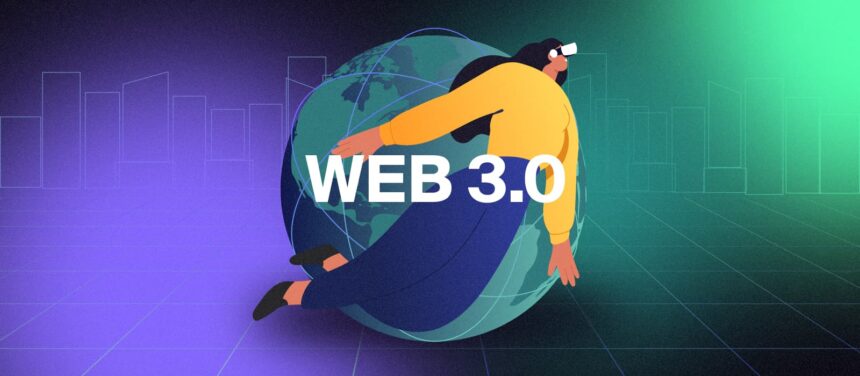
Web3 is a broad term for a proposed evolution of the internet in which users can interact with digital services through decentralized networks, blockchain-based applications, cryptographic wallets, tokens, and smart contracts. Instead of relying entirely on centralized companies to store data, manage accounts, process transactions, and control digital assets, Web3 aims to distribute some of these functions across networks of participants.
- What Is Web3?
- How Did the Internet Evolve From Web1 to Web3?
- How Does the Decentralized Internet Work?
- Step 1: The User Connects a Wallet
- Step 2: The User Interacts With a dApp
- Step 3: A Smart Contract Executes the Rules
- Step 4: The Blockchain Network Validates the Transaction
- Step 5: The Application Reads the Updated State
- What Technologies Power Web3?
- What Are Decentralized Applications?
- Decentralized Finance
- NFTs and Digital Ownership
- Blockchain Gaming
- Decentralized Social Networks
- Tokenized Real-World Assets
- Web3 vs Web2: What Is the Difference?
- What Are the Benefits of Web3?
- What Are the Risks and Limitations of Web3?
- Smart Contract Vulnerabilities
- Private-Key Loss
- Phishing and Wallet Attacks
- Blockchain Fees
- Scalability
- Privacy
- Regulatory Uncertainty
- Centralization Hidden Behind Decentralization
- Is Web3 Really Decentralized?
- Web3 Adoption and Industry Scale
- Web3 and Decentralized Finance
- Web3 and Digital Wallets
- Web3 and Smart Contracts
- Web3 and Tokenized Real-World Assets
- Web3 and Cryptocurrencies: Are They the Same?
- What Is the Future of Web3?
- How Can Businesses Use Web3?
- Frequently Asked Questions
- What is Web3 in simple terms?
- Is Web3 the same as cryptocurrency?
- How does Web3 work?
- What is a Web3 wallet?
- What are dApps?
- What is a smart contract in Web3?
- Is Web3 completely decentralized?
- Is Web3 secure?
- What is the difference between Web2 and Web3?
- Can Web3 replace the current internet?
- What are the main benefits of Web3?
- What are the biggest Web3 risks?
- Why is blockchain important to Web3?
- Does Web3 require blockchain?
The idea is closely associated with blockchain technology, cryptocurrencies, decentralized applications (dApps), digital ownership, decentralized finance (DeFi), non-fungible tokens (NFTs), decentralized identity, and tokenized assets. However, Web3 is not simply another name for cryptocurrency, and not every blockchain application is necessarily a complete Web3 application.
The U.S. National Institute of Standards and Technology (NIST) describes Web3 as a proposed vision for a more user-centric internet emphasizing decentralized data, user management of personal information, digital tokens, and web-native currencies. NIST also emphasizes that these developing technologies introduce new security considerations.
The concept is increasingly relevant because blockchain networks are no longer limited to digital currencies. They are being used to build financial applications, digital identity systems, gaming platforms, tokenized assets, decentralized exchanges, social applications, infrastructure networks, and other software services.
At the same time, Web3 remains an evolving architecture rather than a finished replacement for the existing internet. Many applications still depend on centralized infrastructure, and important challenges remain around scalability, security, privacy, user experience, governance, regulation, and decentralization.
This guide explains what Web3 is, how the decentralized internet works, which technologies make it possible, how Web3 differs from Web2, where it is being used, and what users and businesses should understand before adopting it.
What Is Web3?
Web3 refers to a vision of an internet where users can have greater control over digital assets, identities, transactions, and interactions through decentralized technologies.
Ethereum’s official documentation describes Web3 as a broad vision built around concepts such as decentralization, permissionless participation, native digital payments, and user ownership. It also uses the shorthand “read-write-own” to distinguish the Web3 concept from the earlier read-only and read-write models of the web.
The term itself does not describe one specific technology. Instead, Web3 is an ecosystem that can include:
- Blockchain networks
- Smart contracts
- Cryptographic wallets
- Digital tokens
- Cryptocurrencies
- Decentralized applications
- Decentralized finance
- NFTs
- Decentralized identity
- Distributed storage
- Blockchain-based governance
- Tokenized real-world assets
- Layer-2 scaling networks
The important distinction is that Web3 attempts to move some forms of control from centralized application providers toward protocols, networks, smart contracts, and users.
For example, in a conventional Web2 application, a company typically controls the database, user accounts, authentication system, application logic, and payment infrastructure. In a Web3 application, some of those functions can instead be handled by blockchain networks and smart contracts.
That does not mean the company disappears. A Web3 application may still have a website, development team, centralized servers, customer support, administrators, and other conventional components.
Web3 is therefore better understood as a spectrum of decentralization rather than an absolute state in which everything is distributed.
How Did the Internet Evolve From Web1 to Web3?
Understanding Web3 becomes easier when it is compared with earlier stages of the internet.
Web1: The Read-Only Web
Web1 broadly describes the early commercial and public web, where websites primarily delivered information to users.
A typical user could visit a website, read an article, view an image, or navigate between pages, but interaction and user-generated content were relatively limited.
The architecture was predominantly centralized: organizations owned websites and servers, while users consumed information.
Web2: The Read-Write Web
Web2 introduced much greater user participation.
Social networks, video-sharing platforms, cloud applications, online marketplaces, blogs, messaging platforms, and collaborative software allowed users to create and share content.
However, these services generally remained controlled by centralized companies.
A social media company may store your profile, posts, messages, social graph, and account credentials in centralized systems. A payment company may control your account balance and transaction permissions. A gaming company may control your in-game assets.
This model has produced enormous benefits, including convenient services, high performance, centralized customer support, and relatively simple user experiences.
Web3: The Read-Write-Own Model
Web3 proposes adding a stronger concept of digital ownership.
Instead of an application provider being the only party capable of determining who owns or controls a digital asset, blockchain networks can provide publicly verifiable records of token ownership.
Ethereum’s Web3 documentation describes this concept as a shift toward ownership, where users can control assets through blockchain-based accounts and wallets.
This does not mean that every Web3 asset is legally equivalent to property in the physical world. Ownership rights depend on the particular token, smart contract, legal framework, and application.
The more precise idea is that blockchain technology can provide cryptographically verifiable control over blockchain-based assets.
How Does the Decentralized Internet Work?
Web3 applications generally combine several technological layers rather than relying on one system.
At a simplified level, the process looks like this:
User → Wallet → Web3 Application → Smart Contract → Blockchain → Distributed Network
A user interacts with a decentralized application through a website or application interface. The wallet manages cryptographic credentials and signs transactions. The application communicates with smart contracts. The smart contracts execute predefined rules on a blockchain. The blockchain network validates and records state changes.
NIST describes blockchain as a distributed digital ledger in which records are cryptographically linked and replicated across network participants. This distributed architecture helps provide tamper-evident and tamper-resistant records without requiring a single central repository.
Step 1: The User Connects a Wallet
Instead of creating a traditional username-and-password account, many Web3 applications allow users to connect a blockchain wallet.
The wallet contains or manages cryptographic keys that allow the user to authorize blockchain transactions.
A wallet does not literally store cryptocurrency in the same way a physical wallet stores cash. Blockchain assets remain recorded on the network. The wallet manages the credentials used to control those assets.
NIST notes that blockchain-based token systems can allow users to independently control token custody through digital wallets and public-key cryptography.
Step 2: The User Interacts With a dApp
A decentralized application, or dApp, is an application that uses blockchain-based infrastructure for at least some of its functionality.
A dApp may look like an ordinary website from the user’s perspective.
For example, a decentralized exchange may have:
- A website interface
- Wallet connection
- Smart contracts
- Token balances
- Blockchain transactions
- Decentralized settlement
The user may never see the underlying blockchain mechanics, just as users of traditional banking applications generally do not see the databases and payment systems operating behind the interface.
Step 3: A Smart Contract Executes the Rules
Smart contracts are programs deployed on a blockchain.
Instead of asking a centralized server to determine what happens when a transaction is submitted, a smart contract can execute predefined logic according to its code.
On Ethereum, smart contracts execute within the Ethereum Virtual Machine (EVM). Ethereum’s documentation describes the EVM as the runtime environment where smart contracts and blockchain state changes are processed.
For example, a smart contract might specify:
“If a user deposits token A, calculate the corresponding amount of token B according to the contract’s rules.”
The blockchain network then processes the transaction and records the resulting state.
Step 4: The Blockchain Network Validates the Transaction
The transaction is broadcast to a blockchain network.
Network participants validate transactions according to the blockchain’s consensus mechanism.
Different blockchains use different consensus models, including Proof of Work and Proof of Stake.
Once accepted into the blockchain, the transaction becomes part of the network’s shared state.
NIST explains that blockchain systems use cryptographic mechanisms, distributed records, and consensus processes to create tamper-evident and tamper-resistant ledgers.
Step 5: The Application Reads the Updated State
After the blockchain processes the transaction, the application can read the updated blockchain state and display the result to the user.
This creates a connection between a conventional user interface and decentralized infrastructure.
What Technologies Power Web3?
Web3 is an ecosystem rather than a single technology. Several components work together.
Blockchain
Blockchain provides the distributed ledger or state-management layer for many Web3 systems.
A blockchain maintains records across a network of nodes rather than relying exclusively on one central database.
NIST describes blockchain as a distributed ledger in which transactions are grouped into blocks and cryptographically linked, making unauthorized changes detectable.
Blockchain networks can support digital currencies, smart contracts, token ownership, decentralized applications, and other programmable systems.
Smart Contracts
Smart contracts provide programmable logic.
They can automate processes such as token transfers, decentralized trading, lending, collateral management, governance, and other transactions.
Their major advantage is that execution rules can be enforced by blockchain infrastructure rather than requiring every participant to rely on a conventional intermediary.
However, smart contracts are software and can contain bugs or vulnerabilities. Once deployed, modifying them may also be difficult or require carefully designed upgrade mechanisms.
Cryptographic Wallets
Wallets provide a user-facing mechanism for controlling blockchain accounts and signing transactions.
There are different types of wallets, including:
- Software wallets
- Hardware wallets
- Mobile wallets
- Browser wallets
- Custodial wallets
- Non-custodial wallets
With self-custody, users are generally responsible for protecting their private keys or recovery credentials.
This creates a major difference from Web2 account management.
If you forget a Web2 password, a company may provide account recovery. If you lose access to a self-custodied wallet and have no valid recovery method, there may be no centralized organization capable of restoring access.
Tokens
Tokens represent blockchain-based units of value, rights, access, ownership, or other digital representations.
They can include:
- Fungible tokens
- Stablecoins
- Governance tokens
- Utility tokens
- NFTs
- Tokenized real-world assets
NIST notes that blockchain token systems can support digital ownership and peer-to-peer interactions through public-key cryptography.
Decentralized Storage
Some Web3 applications use distributed or decentralized storage systems rather than storing all content on a company’s centralized servers.
However, decentralized storage does not automatically mean every part of an application is decentralized.
A dApp can use blockchain for transactions while still relying on centralized hosting, APIs, databases, analytics systems, or cloud infrastructure.
This is one reason it is important to evaluate the architecture of a Web3 application instead of assuming that the word “decentralized” describes the entire product.
What Are Decentralized Applications?
Decentralized applications, commonly called dApps, are applications that use blockchain networks and smart contracts for some of their core functionality.
Examples can include:
Decentralized Finance
DeFi applications allow users to access financial functions through blockchain-based protocols.
Examples include:
- Decentralized exchanges
- Lending protocols
- Borrowing platforms
- Stablecoin applications
- Derivatives protocols
- Automated market makers
DeFi is one of the most developed Web3 application categories.
For more detailed coverage, this article can internally link to your existing “What Is Decentralized Finance (DeFi)? A Beginner’s Guide” article using anchor text such as decentralized finance explained or how DeFi works.
NFTs and Digital Ownership
Non-fungible tokens can represent unique blockchain-based assets.
They have been used for digital collectibles, gaming assets, memberships, tickets, certificates, artwork, and other applications.
However, an NFT does not automatically transfer copyright, physical ownership, or all legal rights associated with the underlying item. Those rights depend on the terms attached to the particular asset.
Blockchain Gaming
Web3 gaming can use tokens and NFTs to represent in-game assets.
Instead of every asset existing exclusively inside a company’s centralized database, some game assets can be represented on a blockchain.
This may enable users to transfer certain assets between compatible applications, although actual interoperability remains limited and depends heavily on technical standards and developer support.
Decentralized Social Networks
Web3 social applications attempt to reduce dependence on a single centralized platform.
Depending on the protocol, users may be able to control portable profiles, social graphs, content ownership, or identity credentials.
The practical level of decentralization varies considerably between projects.
Tokenized Real-World Assets
Blockchain technology can also represent financial or physical assets through tokens.
Examples include tokenized government securities, real estate interests, commodities, private credit, investment funds, and other financial claims.
This connects Web3 with traditional finance rather than creating a completely separate financial ecosystem.
An internal link opportunity here would be your existing article “What Is Real-World Asset Tokenization? A Complete Guide,” using anchor text such as real-world asset tokenization.
Web3 vs Web2: What Is the Difference?
The biggest difference between Web2 and Web3 is not simply that one uses blockchain and the other does not. The more meaningful distinction involves how ownership, identity, payments, data, and application logic are managed.
| Feature | Web2 | Web3 |
| Account model | Company-controlled accounts | Wallet or blockchain-based accounts can be used |
| Data | Often stored by centralized providers | Some data/state can be distributed |
| Ownership | Platform may control digital assets | Blockchain tokens can provide user-controlled assets |
| Payments | Banks, cards, payment processors | Blockchain-native payments can be built in |
| Application logic | Centralized servers | Smart contracts can execute on-chain logic |
| Governance | Company or platform controlled | May include community or token-based governance |
| Identity | Usernames, emails, platform profiles | Wallet addresses and decentralized identity systems |
| Infrastructure | Primarily centralized | Can combine centralized and decentralized infrastructure |
Ethereum’s Web2/Web3 documentation makes a similar distinction, describing Web3 applications as decentralized apps running on blockchain networks and highlighting permissionless participation and native payments as important characteristics.
The table should not be interpreted as meaning that every Web3 application possesses all Web3 characteristics or that every Web2 service lacks them.
Modern applications often combine both approaches.
What Are the Benefits of Web3?
Web3’s proposed advantages depend heavily on the specific application and how decentralized its architecture actually is.
Digital Ownership
Blockchain tokens can provide publicly verifiable records of control over digital assets.
This can allow users to hold assets outside a single application’s internal database.
Permissionless Access
Some public blockchain networks allow anyone with an internet connection and compatible software to interact with protocols without opening a conventional account.
This can be particularly relevant to financial applications and global digital services.
However, front-end websites, local regulations, identity requirements, or application-level restrictions can still limit access.
Programmable Transactions
Smart contracts allow transactions and financial arrangements to be encoded as software.
This can automate processes that traditionally require intermediaries.
Transparency
Public blockchains can make transaction histories and smart-contract activity independently verifiable.
This can improve auditability in some contexts.
Transparency is not equivalent to privacy, however. Public blockchain transactions can potentially expose activity patterns associated with addresses.
Global Accessibility
Blockchain networks operate across national borders and time zones.
Ethereum, for example, describes its network as a peer-to-peer system with thousands of nodes communicating through standardized protocols.
This global infrastructure can support applications that operate continuously rather than being restricted to the opening hours or geographic footprint of a particular institution.
What Are the Risks and Limitations of Web3?
Web3 should not be presented as a technology without trade-offs.
NIST’s 2025 security report specifically emphasizes that Web3 technologies introduce novel security challenges that need to be considered when evaluating adoption.
Smart Contract Vulnerabilities
A programming error in a smart contract can potentially result in significant financial or operational consequences.
Audits can reduce some risks but cannot guarantee that software is completely secure.
Private-Key Loss
Self-custody transfers responsibility from centralized institutions to users.
If private keys, seed phrases, or recovery mechanisms are compromised, assets may be stolen or become inaccessible.
Phishing and Wallet Attacks
Attackers can create fake websites, malicious browser extensions, fraudulent tokens, and deceptive transaction requests.
Users should verify domains, transaction details, contract addresses, wallet permissions, and signing requests before approving transactions.
Blockchain Fees
Some networks charge transaction fees that can rise during periods of high demand.
Layer-2 networks and alternative blockchain architectures are being developed partly to address scalability and cost challenges.
Scalability
Blockchain networks have historically faced trade-offs involving throughput, decentralization, latency, and security.
Scaling approaches include Layer-2 networks, rollups, sidechains, alternative consensus designs, and improvements to base-layer protocols.
Privacy
Many public blockchains are pseudonymous rather than anonymous.
A wallet address does not necessarily display a person’s legal name, but blockchain activity can be publicly observable. If an address becomes linked to an identifiable individual, historical and future activity associated with that address may become easier to analyze.
Regulatory Uncertainty
Web3 applications can involve financial products, securities, payments, consumer protection, privacy, taxation, intellectual property, and other regulated areas.
The regulatory status of a token or service depends on its characteristics and jurisdiction.
Businesses should obtain qualified legal and compliance advice before launching regulated Web3 products.
Centralization Hidden Behind Decentralization
A project may market itself as decentralized while depending heavily on centralized infrastructure.
For example, a Web3 application might use:
- Centralized web hosting
- Centralized APIs
- One primary development company
- A small number of validators
- A centralized administrator key
- A proprietary database
- Centralized identity providers
This does not necessarily make the project illegitimate, but it means the actual architecture should be evaluated rather than relying on marketing language.
Is Web3 Really Decentralized?
This is one of the most important questions to ask.
The answer depends on which layer of the system is being examined.
A blockchain may have thousands of independent nodes while a Web3 application’s front end is hosted by one company.
Similarly, a protocol may use a decentralized blockchain while relying on centralized oracle providers to obtain external information.
NIST’s Web3 security research emphasizes that decentralization is a proposed architectural characteristic rather than a guarantee of security.
Therefore, evaluating Web3 decentralization requires looking at the full stack:
- Who controls the blockchain?
- How many independent validators or nodes exist?
- Who controls the smart contracts?
- Can contracts be upgraded?
- Who controls administrator keys?
- Where is application data stored?
- Who controls the front end?
- How are external data feeds provided?
- Can users interact directly with the protocol?
- Can assets move without permission from a central operator?
These questions provide a much more useful picture than simply asking whether a project calls itself Web3.
Web3 Adoption and Industry Scale
Web3 is not merely a theoretical concept, although its adoption metrics require careful interpretation.
A16z’s 2025 State of Crypto report estimated roughly 40–70 million active crypto users, while separately estimating about 716 million people who owned cryptocurrency. The report also estimated approximately 181 million monthly active blockchain addresses. These figures are not direct counts of unique Web3 individuals because blockchain addresses can be controlled by the same person and user measurement is inherently difficult.
The same report estimated that blockchains were processing more than 3,400 transactions per second in 2025, representing more than 100 times growth over five years according to its methodology. It also reported that the total crypto market capitalization crossed $4 trillion during 2025.
These statistics describe the broader crypto and blockchain ecosystem rather than Web3 applications alone. That distinction matters because cryptocurrency ownership, blockchain activity, DeFi usage, NFT activity, and Web3 application usage are overlapping but not identical categories.
Global adoption is also geographically diverse. Chainalysis reported that Asia-Pacific on-chain crypto activity increased 69% year over year in the 12 months ending June 2025, reaching approximately $2.36 trillion in value received. Its 2025 index ranked India first, the United States second, Pakistan third, Vietnam fourth, and Brazil fifth.
These numbers demonstrate substantial blockchain activity, but they should not be interpreted as proof that all users have adopted a fully decentralized internet.
Web3 and Decentralized Finance
DeFi is one of the clearest examples of how Web3 changes the structure of an online financial service.
A conventional financial application typically relies on institutions to maintain accounts, process payments, verify transactions, and enforce rules.
A DeFi protocol can encode some of these functions into smart contracts.
Users interact with the protocol through wallets, while blockchain transactions provide settlement.
DeFi can include decentralized exchanges, lending protocols, stablecoins, derivatives, liquidity systems, and asset-management applications.
However, DeFi also introduces risks such as smart-contract vulnerabilities, oracle failures, liquidity risks, market volatility, governance risks, and transaction-fee exposure.
For readers interested in this area, the site’s existing “What Is Decentralized Finance (DeFi)? A Beginner’s Guide” article would make a strong supporting internal link.
Web3 and Digital Wallets
Wallets are fundamental to many Web3 experiences.
A wallet may allow a user to:
- Hold blockchain-based assets
- Send and receive tokens
- Connect to dApps
- Sign messages
- Approve smart-contract transactions
- Manage multiple blockchain accounts
The security model is significantly different from conventional internet accounts.
With a self-custodial wallet, the user generally controls the credentials needed to authorize transactions.
This creates both ownership and responsibility.
An internal link to your existing “Crypto Wallet Explained: Hot Wallet vs Cold Wallet” article would fit naturally here. Suggested anchor text includes crypto wallet security, hot vs cold wallets, or how crypto wallets work.
Web3 and Smart Contracts
Smart contracts are one of the most important technologies behind Web3.
They allow developers to encode rules that execute on blockchain infrastructure.
For example, a smart contract can be programmed to:
- Transfer tokens
- Issue NFTs
- Manage lending conditions
- Facilitate decentralized exchanges
- Record governance votes
- Distribute funds
- Manage tokenized assets
Ethereum’s architecture uses the EVM as the execution environment for smart contracts, with thousands of nodes distributed globally.
For deeper topical coverage, link this section to the existing “Smart Contracts Explained: How They Power Modern Blockchain Applications” article using anchor text such as smart contracts explained or how smart contracts work.
Web3 and Tokenized Real-World Assets
One emerging Web3 use case involves representing real-world assets or financial claims through blockchain-based tokens.
Examples can include government securities, investment funds, commodities, private credit, and real estate-related interests.
The concept is sometimes called real-world asset tokenization or RWA tokenization.
The value proposition is not simply putting an asset “on a blockchain.” A functioning tokenization system needs legal rights, custody arrangements, asset servicing, valuation processes, smart contracts, compliance controls, and reliable connections between on-chain tokens and off-chain assets.
This creates another important internal linking opportunity to the site’s existing articles:
- “What Is Real-World Asset Tokenization? A Complete Guide”
- “What Are RWA Tokens? A Complete Guide to Real-World Asset Tokens”
Suggested anchors include real-world asset tokenization and what are RWA tokens.
Web3 and Cryptocurrencies: Are They the Same?
No.
Cryptocurrency is one component of the broader Web3 ecosystem.
Bitcoin, for example, is a decentralized digital currency and blockchain network. Web3 encompasses a much wider set of applications and infrastructure.
A Web3 application may use cryptocurrency for:
- Payments
- Transaction fees
- Governance
- Incentives
- Collateral
- Settlement
But Web3 can also involve NFTs, identity credentials, tokenized assets, decentralized storage, gaming, social applications, and other technologies.
For a deeper explanation, your existing “Proof of Work vs Proof of Stake” and “What Is Crypto Staking?” articles can serve as supporting links when discussing blockchain consensus and network participation.
What Is the Future of Web3?
The future of Web3 is likely to involve a mixture of decentralized and centralized technologies rather than an overnight replacement of today’s internet.
Several developments are particularly important.
Layer-2 scaling can make blockchain applications faster and less expensive.
Tokenization can connect traditional financial assets with programmable blockchain infrastructure.
Stablecoins can provide blockchain-based payment and settlement mechanisms.
Decentralized identity systems may allow users to prove selected attributes without relying entirely on centralized accounts.
Web gaming and social applications may experiment with portable assets and identities.
Enterprise blockchain systems may use permissioned or hybrid architectures rather than fully public networks.
The broader trend is therefore less about replacing every existing website and more about determining which functions benefit from decentralized infrastructure.
How Can Businesses Use Web3?
Businesses considering Web3 should start with the business problem rather than the technology label.
Potential applications include:
- Tokenized loyalty programs
- Digital memberships
- Blockchain-based certificates
- Asset tokenization
- Cross-border settlement
- Digital identity
- Gaming assets
- Decentralized marketplaces
- Creator monetization
- Supply-chain verification
- Community governance
- Blockchain-based financial applications
Before implementation, businesses should evaluate whether blockchain actually provides a meaningful advantage over a conventional database or payment system.
NIST specifically encourages organizations to understand blockchain technology and its limitations before determining where it is appropriate.
A good Web3 strategy should consider architecture, user experience, security, regulatory requirements, custody, privacy, interoperability, scalability, and long-term maintenance.
Final Takeaway
Web3 represents a proposed evolution of the internet centered on decentralization, digital ownership, programmable transactions, and greater user control.
Blockchain provides much of the underlying infrastructure. Smart contracts provide programmable logic. Wallets provide a mechanism for users to control blockchain accounts. Tokens can represent digital assets or other rights. Decentralized applications connect these technologies to real-world use cases.
The ecosystem has already developed beyond cryptocurrency into DeFi, NFTs, gaming, tokenized assets, identity, payments, and other applications. Current industry data also shows substantial blockchain and crypto activity worldwide, although metrics such as active addresses should not automatically be interpreted as unique Web3 users.
At the same time, Web3 is not automatically decentralized, secure, private, or user-friendly simply because a product uses blockchain. The underlying architecture, governance, custody model, smart contracts, infrastructure dependencies, and regulatory environment all matter.
For users, understanding wallets, private keys, transaction signing, smart contracts, and security practices is essential. For businesses, the starting point should be a clear problem that decentralized infrastructure can solve better or differently than conventional technology.
Ultimately, Web3 is best understood not as a finished replacement for Web2, but as an evolving set of technologies and architectural approaches that are changing how digital ownership, payments, applications, and online coordination can work.
Frequently Asked Questions
What is Web3 in simple terms?
Web3 is a proposed version of the internet that uses technologies such as blockchain, smart contracts, digital wallets, and tokens to give users greater control over digital assets and interactions.
Is Web3 the same as cryptocurrency?
No. Cryptocurrency is one component of Web3. Web3 is a broader concept that can include decentralized applications, smart contracts, NFTs, decentralized finance, digital identity, tokenization, and decentralized infrastructure.
How does Web3 work?
Web3 applications can connect users through cryptographic wallets to blockchain networks and smart contracts. Transactions are validated by the blockchain network and recorded in a distributed ledger.
What is a Web3 wallet?
A Web3 wallet is a software or hardware tool that manages cryptographic credentials and allows users to interact with blockchain networks and decentralized applications.
What are dApps?
dApps, or decentralized applications, are applications that use blockchain networks and smart contracts for some of their core functionality. Their exact level of decentralization varies from project to project.
What is a smart contract in Web3?
A smart contract is blockchain-based software that executes predefined rules. Smart contracts can automate transactions, token transfers, financial operations, governance, and other digital processes.
Is Web3 completely decentralized?
Not necessarily. A Web3 project can use decentralized blockchain infrastructure while relying on centralized hosting, APIs, development teams, administrators, or other services. The actual architecture must be examined to determine where control is distributed.
Is Web3 secure?
Web3 can provide strong cryptographic and distributed security properties, but it also introduces risks such as smart-contract bugs, phishing, private-key theft, malicious tokens, compromised infrastructure, and governance vulnerabilities. NIST specifically highlights security challenges associated with the Web3 paradigm.
What is the difference between Web2 and Web3?
Web2 generally relies on centralized platforms that control accounts, data, application infrastructure, and many digital services. Web3 aims to distribute some of these functions through blockchain networks, smart contracts, wallets, and token-based ownership.
Can Web3 replace the current internet?
There is no established basis for saying that Web3 will completely replace today’s internet. In practice, Web3 applications currently combine decentralized technologies with conventional web infrastructure, and the ecosystem continues to evolve.
What are the main benefits of Web3?
Potential benefits include user-controlled digital assets, programmable transactions, peer-to-peer interactions, transparent blockchain records, permissionless access to some protocols, and globally accessible digital infrastructure.
What are the biggest Web3 risks?
Major risks include smart-contract vulnerabilities, wallet and private-key security, scams and phishing, privacy limitations, network fees, scalability constraints, regulatory uncertainty, governance risks, and centralization at certain layers of the technology stack.
Why is blockchain important to Web3?
Blockchain provides a shared, cryptographically secured state layer that can allow multiple participants to interact without relying entirely on one centralized database or intermediary. NIST identifies distributed ledgers, cryptography, and consensus as fundamental components of blockchain systems.
Does Web3 require blockchain?
Most definitions of Web3 place blockchain and decentralized technologies at the center of the concept. However, the exact meaning of Web3 is still evolving, and different projects use different combinations of blockchain, peer-to-peer networks, decentralized storage, cryptography, and other technologies.
If you want to contribute your piece of content on Crypto, Bitcoins and other digital currencies for Bitsoz, You can search for us in Google with queries like “write for us crypto”. “Write for us bitcoins” or directly contact us and let us know what you want.