
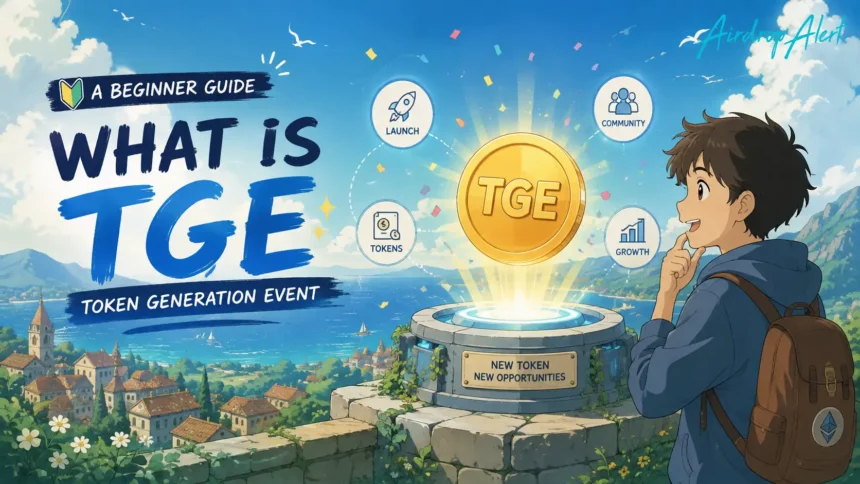
A Token Generation Event (TGE) is an important milestone in a blockchain project’s lifecycle. It refers to the process through which a project creates and issues its cryptocurrency token, often alongside the initial distribution of tokens to investors, community members, contributors, or ecosystem participants. Depending on the project, a TGE may also coincide with a token sale, an airdrop, the launch of decentralized exchange liquidity, or the first exchange listing.
- What Is a Token Generation Event (TGE)?
- How Does a Token Generation Event Work?
- 1. Project development and token design
- 2. Smart contract development and testing
- 3. Token supply creation and allocation
- 4. Token distribution or claiming
- 5. Liquidity provision and market access
- 6. Post-launch operations
- What Is the Difference Between TGE, ICO, IDO, and IEO?
- Understanding Tokenomics Before a TGE
- What Are Token Vesting and Token Unlocks?
- Market Capitalization vs. Fully Diluted Valuation
- What Happens to Token Prices After a TGE?
- Initial demand and market expectations
- Selling pressure from early participants
- Liquidity and price volatility
- How to Evaluate a TGE Before Participating
- Common TGE Risks and Scams
- Why Token Generation Events Matter to Web3 Ecosystems
- Conclusion
- Frequently Asked Questions
- 1. What does TGE stand for in crypto?
- 2. Is a TGE the same as an ICO?
- 3. Does a token become tradable immediately after a TGE?
- 4. What is the difference between TGE and token listing?
- 5. What happens to token prices after a TGE?
- 6. What is token vesting after a TGE?
- 7. What is a token unlock?
- 8. How do I evaluate a token before its TGE?
- 9. Can I participate in a TGE without buying tokens?
- 10. Is a TGE a guaranteed investment opportunity?
- 11. What is the difference between market capitalization and FDV?
- 12. Are TGEs regulated?
For crypto investors, developers, and Web3 users, understanding a token generation event is essential because it can influence token availability, circulating supply, governance participation, and market behavior. However, a TGE does not automatically mean that a token is available to everyone, listed on a major exchange, or guaranteed to increase in value.
Consider a blockchain startup developing a decentralized finance (DeFi) platform. Before its token launch, the project may operate an application, attract users, distribute testnet rewards, and raise funds from early investors. During the TGE, it may deploy its token smart contract, mint or initialize the token supply, and distribute a portion of the tokens according to its published tokenomics. Some tokens may become transferable immediately, while others remain locked under vesting schedules.
This process involves more than creating a digital asset. It requires decisions about token utility, supply allocation, security, liquidity, distribution, and regulatory obligations.
According to the official Ethereum documentation, the ERC-20 token standard defines a common interface for fungible tokens, including functions for transferring tokens, checking balances, and approving third-party spending. The standard was proposed in November 2015 and helped make Ethereum tokens interoperable with wallets, decentralized exchanges, and other applications. Not every TGE uses ERC-20, but the standard illustrates the technical foundation behind many token launches.
This guide explains what a TGE means, how it works, how it differs from an ICO and an exchange listing, what tokenomics and vesting reveal, and how to evaluate a token launch without relying on hype or unrealistic return expectations.
What Is a Token Generation Event (TGE)?
A Token Generation Event is the process through which a blockchain project creates and issues a new digital token. It commonly marks the transition from a project’s development or fundraising stage to a phase in which tokens are distributed to eligible participants and potentially become usable or transferable.
The exact meaning of TGE varies between projects. Some use the term for the technical creation and issuance of tokens. Others use it more broadly to describe the entire launch process, including the initial distribution, token claim, liquidity deployment, or exchange trading.
A TGE may involve a governance token, utility token, ecosystem token, or another type of blockchain-based asset. The token might allow holders to vote on protocol proposals, access specific services, pay fees, participate in an application, or interact with a decentralized network.
However, a token’s advertised purpose should not be confused with a guarantee of economic value. A governance token does not necessarily represent company shares, and holding a utility token does not automatically entitle its owner to profits or revenue.
For example, a decentralized application may issue a token to support community governance. At the TGE, eligible users receive their allocations, the token contract becomes available on the relevant blockchain, and the project publishes instructions for claiming or using the asset. Whether the token can immediately be sold depends on its contract design, distribution rules, liquidity, and any applicable restrictions.
In simple terms, a TGE is a token issuance milestone—not proof that a project is successful, secure, legally compliant in every jurisdiction, or a good investment.
How Does a Token Generation Event Work?
A TGE usually involves several stages, although the exact sequence differs by blockchain, project, and distribution model.
1. Project development and token design
Before issuing a token, the team defines its intended role in the ecosystem. This may involve governance, network participation, payment for services, incentives, or access to particular features.
The project also develops its tokenomics, which describe how the token supply is structured and allocated. Important decisions include the maximum supply, initial circulating supply, allocation for the community, investor allocations, team reserves, ecosystem incentives, and the schedule under which locked tokens may become available.
A well-designed token should have a clearly explained purpose. If the product works without the token, the team should explain why the token is necessary and what value or functionality it adds.
2. Smart contract development and testing
The project develops the smart contract or blockchain mechanism responsible for creating, tracking, and transferring the token.
On Ethereum-compatible networks, fungible tokens commonly use the ERC-20 standard. Its interface includes functions such as totalSupply, balanceOf, transfer, and approve. These functions allow compatible wallets and applications to interact with the token in a predictable way.
Other blockchain networks may use different token standards and native issuance mechanisms.
Before deployment, the team should test the contract, examine permissions, and assess security risks. Depending on the project, this may include independent audits, testnet deployments, formal verification, or other security reviews. An audit can help identify vulnerabilities, but it does not guarantee that a contract or project is safe.
3. Token supply creation and allocation
At or around the TGE, the token supply is created, initialized, or made available according to the project’s design. Some tokens are minted at deployment, while other contracts allow additional issuance under specified rules.
The project then allocates tokens to relevant participants. These may include early investors, team members, strategic partners, community contributors, airdrop recipients, ecosystem funds, and liquidity programs.
Allocation percentages matter because they influence how token ownership is distributed. A project with a large team or investor allocation may have different concentration and selling-pressure risks from one that distributes more tokens to a broad user base.
A published allocation chart should explain both the percentage assigned to each group and the conditions under which those tokens become transferable.
4. Token distribution or claiming
Tokens may be distributed automatically to eligible addresses or claimed through an official interface. Some projects use airdrops, launchpads, private sales, public sales, or other mechanisms.
A claim process may require a wallet connection and an on-chain transaction. Depending on the blockchain, users may need native network tokens to pay transaction fees.
Users should verify the official claim website and contract address through trusted project documentation. Fake TGE announcements and imitation claim pages can be designed to trick users into signing malicious transactions or revealing wallet recovery information.
5. Liquidity provision and market access
A project may establish liquidity on a decentralized exchange or arrange trading through a centralized exchange. This stage may occur at the TGE, shortly afterward, or on a different schedule.
The availability of a token contract does not automatically mean a liquid market exists. A token can be technically transferable while having little trading volume, limited liquidity, or no reliable market price.
Projects should communicate where trading is supported, which contract address is official, and whether any transfer restrictions apply. Users should also distinguish between a token being created, a claim becoming available, and trading actually opening.
6. Post-launch operations
After the TGE, the team may continue developing the product, releasing locked tokens according to the vesting schedule, managing ecosystem incentives, and implementing governance processes.
The post-launch period can reveal whether the project delivers on its roadmap and whether the token has a meaningful role in the ecosystem. A successful TGE is therefore not the end of project development; it is one stage in a longer process.
What Is the Difference Between TGE, ICO, IDO, and IEO?
TGE, ICO, IDO, and IEO are related terms, but they describe different aspects of a token launch.
A TGE focuses on token issuance. An ICO, IDO, or IEO describes a particular fundraising or distribution approach. These events may occur together, but they are not interchangeable.
| Term | Meaning | Main purpose |
| THE | Token Generation Event | Create and issue a project’s token |
| ICO | Initial Coin Offering | Sell tokens directly through a project-organized offering |
| IDO | Initial DEX Offering | Launch or distribute tokens through a decentralized exchange or related launch platform |
| IEO | Initial Exchange Offering | Conduct a token offering through a centralized exchange |
| Airdrop | Distribution of tokens to eligible addresses | Reward or distribute tokens to users or community members |
| Token listing | Making a token available for trading on an exchange | Provide a market where users can buy or sell the token |
TGE vs. ICO
An ICO is generally a fundraising mechanism in which participants purchase tokens from a project. A TGE may occur alongside an ICO, but a project can also issue tokens without conducting a public token sale.
For example, a protocol might distribute its initial tokens to users and contributors rather than sell them directly to the public. That can still be described as a TGE even though no ICO takes place.
TGE vs. IDO
An IDO typically involves a decentralized exchange or launch platform as part of the token offering. A TGE refers to the issuance process itself.
A project might conduct an IDO and then issue or distribute tokens as part of its launch. However, the IDO’s existence does not guarantee that the token will maintain liquidity or trade at the initial offering price.
TGE vs. IEO
An IEO is generally organized through a centralized exchange, which may impose listing, participation, or project-review requirements. The TGE is the token issuance event and may occur alongside the exchange offering.
Users should understand the specific exchange’s role rather than assuming that an exchange-hosted offering guarantees the project’s quality or the token’s future performance.
TGE vs. token listing
This is one of the most important distinctions for new crypto users. A token can be generated before it is listed on an exchange. Similarly, a token may be distributed to eligible wallets before broad trading begins.
A listing can improve access to trading, but it does not create guaranteed demand. Market price still depends on liquidity, supply, buyer and seller behavior, project fundamentals, and broader market conditions.
Understanding Tokenomics Before a TGE
Tokenomics refers to the economic design of a cryptocurrency token, including its supply, distribution, incentives, and mechanisms that may influence demand.
Before evaluating a token generation event, examine the tokenomics documentation rather than focusing only on the announced launch price or promotional claims.
Total supply and maximum supply
Total supply generally refers to the number of tokens currently created, subject to the specific reporting methodology and token contract. Maximum supply refers to the upper limit that can be issued, if the design defines one.
These figures are not always identical. A project may create tokens gradually, burn tokens, or permit additional issuance under defined conditions. Investors should read the contract and documentation to understand the supply model.
Initial circulating supply
Initial circulating supply is the quantity of tokens expected to be available in the market at launch or during the initial trading period.
This figure matters because a project can have a large total supply while only a small percentage is initially transferable. A low initial circulating supply may make the token’s early market capitalization look modest relative to its fully diluted valuation.
However, a small circulating supply can also mean that future unlocks will materially increase the number of tokens available for trading.
Token allocation
A token allocation chart should explain how the supply is divided among categories such as the community, team, investors, treasury, ecosystem development, and liquidity incentives.
The percentages alone do not tell the whole story. A 20% team allocation that unlocks gradually over several years creates a different short-term supply profile from a 20% allocation that becomes transferable immediately.
Users should look for clear vesting conditions, cliff periods, unlock dates, and information about who controls treasury tokens.
Utility and demand
A token’s potential demand depends partly on whether it has a meaningful role in its ecosystem. Possible uses include paying protocol fees, participating in governance, accessing services, securing a network, or supporting ecosystem incentives.
But utility does not automatically create sufficient demand to support a particular market price. Some applications can function without requiring users to hold the token, and governance rights may have limited value if participation is low or decision-making remains concentrated.
A credible project should explain how the token fits into the product and why its design is preferable to alternatives.
What Are Token Vesting and Token Unlocks?
Vesting is a schedule that determines when allocated tokens become available to their recipients. Projects often use vesting to align incentives over time and prevent all tokens allocated to insiders from becoming transferable immediately.
A vesting schedule may include a cliff period, followed by gradual releases over months or years.
For example, imagine that a project allocates 10 million tokens to its founding team. The tokens have a 12-month cliff and then vest monthly over the following 36 months. Under this hypothetical schedule, no team tokens become available during the first 12 months, after which the vested portion is released gradually.
This is only an illustration; actual schedules vary and must be checked in the project’s official documents.
A token unlock is the point at which previously restricted tokens become available under the vesting or release rules. An unlock does not necessarily mean that every recipient will immediately sell. Some may continue holding, stake tokens, participate in governance, or use them within the ecosystem.
Nevertheless, large unlocks can increase potential selling pressure, particularly when the market has limited liquidity or recipients have strong incentives to realize gains.
Why vesting matters to token price
Suppose a project launches with 100 million tokens circulating out of a total supply of 1 billion. Its initial circulating supply is 10% of the total.
If another 50 million tokens become transferable later, the available supply may increase by 50% relative to the original 100 million, assuming the initial circulating figure and unlock are measured consistently and no other supply changes occur.
This does not mean the price must fall. Market demand may rise at the same time, and some unlocked tokens may not be sold. However, the example shows why investors should track circulating supply and unlock schedules instead of evaluating only the launch price.
Market Capitalization vs. Fully Diluted Valuation
Two common measures used to assess a newly launched token are market capitalization and fully diluted valuation (FDV).
Market capitalization is generally calculated by multiplying the current token price by the circulating supply. FDV is commonly calculated by multiplying the current token price by the total or maximum supply, depending on the data provider’s methodology.
Consider a hypothetical token with a market price of $2, a circulating supply of 50 million tokens, and a maximum supply of 1 billion tokens.
Its implied market capitalization would be:
50 million × $2 = $100 million.
Its fully diluted valuation using the 1 billion maximum supply would be:
1 billion × $2 = $2 billion.
The large difference between these two figures does not prove that the token is overvalued, but it shows why the launch market capitalization alone can be misleading. If many tokens are locked initially and become available later, investors need to understand how supply growth could affect the market.
FDV also has limitations. It assumes the same price applies to all tokens in the supply calculation, even though the market may not be able to absorb large amounts of additional selling at that price.
A more complete assessment considers market capitalization, FDV, liquidity depth, trading volume, token distribution, and the timing of future unlocks.
What Happens to Token Prices After a TGE?
There is no universal price pattern following a token generation event. Some tokens rise after launch, while others decline sharply or trade sideways.
The price depends on several interacting factors, including initial demand, launch valuation, circulating supply, exchange access, liquidity, investor expectations, and overall crypto market conditions.
Initial demand and market expectations
A project with a useful product, an active user base, and credible token utility may attract attention. However, strong publicity does not necessarily translate into sustained demand.
If the initial market price already reflects highly optimistic expectations, the token may struggle to rise further. Conversely, demand can increase when the token provides practical utility or when more participants enter the ecosystem.
Selling pressure from early participants
Early investors, airdrop recipients, and other token holders may have different reasons for selling. Some may take profits, reduce exposure, or convert the token into other assets.
When a large number of holders can sell at the same time, the market may experience temporary selling pressure. The impact depends on liquidity and the amount of demand available to absorb those sales.
Liquidity and price volatility
Liquidity refers to how easily an asset can be bought or sold without causing a substantial change in price. A token with limited liquidity can experience large price movements even when the number of tokens traded is relatively small.
Newly launched tokens may also have limited price history, making conventional technical analysis less reliable. Early price movements should not be interpreted as proof of long-term value.
How to Evaluate a TGE Before Participating
A structured assessment can help separate a project’s fundamentals from launch marketing.
Start with the product and the team. Review what the project does, whether a functioning product exists, who is responsible for development, and whether its roadmap contains measurable goals. Look for transparent documentation and a credible explanation of the token’s role.
Next, examine tokenomics. Review the maximum supply, initial circulating supply, allocation percentages, vesting schedule, and token unlock calendar. Consider whether the distribution is concentrated among a small number of insiders and whether the project clearly explains treasury control.
Then evaluate the technical design. Verify the official token contract, the blockchain on which it is deployed, and any available audit reports. Read audit findings carefully because an audit does not eliminate every possible vulnerability or operational risk.
Assess the launch mechanism as well. If the project uses an ICO, IDO, or IEO, understand the participation rules, eligibility restrictions, fees, and refund conditions, if any. Do not assume that a launchpad or exchange has guaranteed the token’s safety or future market value.
Finally, examine the market structure. Identify where the token can actually be traded, whether meaningful liquidity exists, and how much supply may become available in the coming months. A project can have an impressive website and a large announced token supply without offering a sustainable market.
Common TGE Risks and Scams
Token launches can expose users to technical, financial, operational, and regulatory risks.
One risk is a fraudulent project that raises funds or distributes a token without delivering the promised product. Another is a malicious token contract that includes dangerous permissions or mechanisms that can restrict transfers, create new tokens, or otherwise disadvantage holders.
Some projects advertise exaggerated returns, guaranteed allocations, or secret access to a TGE. Such claims should be treated with caution. A legitimate token launch does not require users to disclose a seed phrase or private key.
Fake claim pages are another common danger. An attacker may copy the branding of a real project and encourage users to connect a wallet and sign a malicious transaction. Always verify the official website and contract address independently.
There are also market risks. Token prices can fall significantly after launch, liquidity may disappear, and large unlocks can affect supply. Even a technically sound project may fail to attract enough users or develop sustainable demand.
Regulatory treatment varies by jurisdiction and the facts of the offering. In the United States, the Securities and Exchange Commission explains that crypto assets and transactions can fall within federal securities laws depending on the circumstances, including whether an offering involves an investment contract. Other jurisdictions apply their own laws and requirements.
For general guidance, see the US Commodity Futures Trading Commission’s digital asset advisory and the SEC’s information on transactions involving crypto assets. These sources are educational references, not a substitute for jurisdiction-specific legal advice.
Why Token Generation Events Matter to Web3 Ecosystems
TGEs can help blockchain projects distribute governance rights, reward early contributors, fund ecosystem incentives, and establish a token-based economic model.
In decentralized finance, a token may support governance or other protocol functions. In gaming, tokens may be used for in-game economies or access to ecosystem features. In infrastructure projects, a token may support network participation or incentives, depending on the protocol’s design.
A TGE can also broaden participation by distributing tokens to users who helped test or develop a project. Retroactive airdrops are one example of this approach: a project may allocate tokens based on historical activity rather than selling every token to investors.
However, token distribution does not automatically create meaningful decentralization. If a small number of wallets control most voting power or treasury assets, decision-making may remain concentrated even when the token is publicly transferable.
A healthy ecosystem therefore needs more than a launch event. It requires useful products, transparent governance, secure infrastructure, sustainable incentives, and a clear relationship between the token and the network’s long-term objectives.
Conclusion
A Token Generation Event is the process through which a blockchain project creates and issues its token, often alongside distribution, liquidity provision, or the beginning of market trading. It is an important milestone, but it should not be confused with an ICO, an IDO, an IEO, or an exchange listing.
Understanding tokenomics, initial circulating supply, vesting schedules, unlocks, market capitalization, and fully diluted valuation helps users evaluate a token more carefully. Reviewing the smart contract, project documentation, security assessments, and applicable regulations is equally important.
For investors and Web3 participants, the most useful approach is to look beyond launch-day excitement. Assess the product, token utility, supply distribution, liquidity, and long-term development plans. Never assume that a TGE guarantees market demand, investment returns, or project success.
A token generation event can mark the beginning of a blockchain project’s economic life, but the project’s long-term value depends on what it builds, how it operates, and whether its token has a credible purpose.
Frequently Asked Questions
1. What does TGE stand for in crypto?
TGE stands for Token Generation Event. It refers to the process of creating and issuing a new cryptocurrency token, often alongside its initial distribution to investors, community members, or other eligible participants.
2. Is a TGE the same as an ICO?
No. A TGE concerns token issuance, while an Initial Coin Offering is a fundraising method in which participants purchase tokens. A project can conduct an ICO as part of its TGE, but it can also issue tokens through an airdrop or another distribution mechanism without a public ICO.
3. Does a token become tradable immediately after a TGE?
Not necessarily. A token may be created before trading opens, and some allocations may remain locked. Tradability depends on the token contract, distribution conditions, transfer restrictions, and whether a market with sufficient liquidity exists.
4. What is the difference between TGE and token listing?
A TGE involves creating and issuing the token. A token listing makes the asset available for trading on an exchange. The two events can happen close together, but they are separate milestones and may occur on different dates.
5. What happens to token prices after a TGE?
Prices may rise, fall, or remain relatively stable. Initial demand, valuation, liquidity, circulating supply, market sentiment, and token unlocks can all influence price movements. There is no reliable rule that newly launched tokens will increase in value.
6. What is token vesting after a TGE?
Token vesting is a schedule that determines when allocated tokens become available to their recipients. Projects may lock team or investor tokens for a set period and then release them gradually to align incentives over time.
7. What is a token unlock?
A token unlock is the release of previously restricted tokens under a vesting or distribution schedule. An unlock can increase the supply available for trading, although recipients do not necessarily sell immediately.
8. How do I evaluate a token before its TGE?
Review the project’s product, team, token utility, supply allocation, circulating supply, vesting schedule, security audits, launch conditions, and expected liquidity. Verify official documentation and avoid relying solely on social media promotions or promised returns.
9. Can I participate in a TGE without buying tokens?
Sometimes. Projects may distribute tokens through community airdrops, rewards, or other eligibility-based programs. However, not every TGE includes a free distribution, and participation requirements vary. Eligibility should be verified through official project sources.
10. Is a TGE a guaranteed investment opportunity?
No. A TGE is a token issuance event, not a guarantee of quality, liquidity, or profitability. Tokens can lose value, projects can fail, and users may encounter scams or smart-contract risks. Evaluate the risks before committing funds.
11. What is the difference between market capitalization and FDV?
Market capitalization is generally calculated using the token price and circulating supply. Fully diluted valuation uses the token price and total or maximum supply, depending on the methodology. A large gap between these measures can indicate that many tokens remain outside the current circulating supply.
12. Are TGEs regulated?
The rules depend on the jurisdiction, the token’s characteristics, how it is offered, and the surrounding facts. Some token offerings or transactions may trigger securities, financial promotion, consumer protection, or other legal requirements. Projects and participants should seek qualified legal advice when necessary.
If you want to contribute your piece of content on Crypto, Bitcoins and other digital currencies for Bitsoz, You can search for us in Google with queries like “write for us crypto”. “Write for us bitcoins” or directly contact us and let us know what you want.