

Bitcoin transactions are often described as taking approximately 10 minutes, but that figure does not tell the whole story. A payment may appear in the recipient’s wallet within seconds, remain unconfirmed for several minutes, or take hours to receive its first blockchain confirmation. The time required for a transaction to become sufficiently secure can be longer still.
- How Long Does a Bitcoin Transaction Take?
- Understanding the Difference Between a Bitcoin Transaction and a Confirmation
- What Does Zero Confirmation Mean?
- What Does One Confirmation Mean?
- What Do Multiple Confirmations Mean?
- Why Does Bitcoin Take Around 10 Minutes to Confirm Transactions?
- How the Bitcoin Transaction Process Works
- 1. The Wallet Creates and Signs the Transaction
- 2. The Transaction Is Broadcast to the Network
- 3. The Transaction Enters the Mempool
- 4. A Miner Includes the Transaction in a Block
- 5. Additional Blocks Increase Settlement Confidence
- Seven Factors That Affect Bitcoin Transaction Time
- 1. Bitcoin Network Congestion
- 2. Bitcoin Transaction Fee
- 3. Transaction Size and Complexity
- 4. Time of Network Activity
- 5. Miner Transaction Selection
- 6. Wallet Fee Estimation
- 7. Confirmation Requirements of the Receiving Platform
- How Long Does a Bitcoin Transaction Take With Different Confirmation Levels?
- Why Is My Bitcoin Transaction Taking So Long?
- The Transaction Fee Is Too Low
- The Mempool Is Busy
- The Wallet Has Not Updated Its Status
- The Transaction Has Not Been Broadcast Successfully
- The Transaction Is Waiting on an Unconfirmed Parent
- How to Speed Up a Slow Bitcoin Transaction
- 1. Use Replace-by-Fee (RBF)
- 2. Use Child Pays for Parent (CPFP)
- 3. Check Current Bitcoin Fee Estimates
- 4. Contact the Exchange or Wallet Provider
- What Happens If a Bitcoin Transaction Remains Unconfirmed for Hours or Days?
- How to Check the Status of a Bitcoin Transaction
- Bitcoin Transaction Time: On-Chain Bitcoin vs. Lightning Network
- Is a Bitcoin Transaction Faster Than a Bank Transfer?
- How Many Bitcoin Confirmations Are Enough?
- Common Bitcoin Transaction Myths Explained
- Myth 1: Every Bitcoin Transaction Takes Exactly 10 Minutes
- Myth 2: A Payment Is Final as Soon as It Appears in a Wallet
- Myth 3: Paying a Higher Fee Guarantees Immediate Confirmation
- Myth 4: Bitcoin Transactions Can Always Be Cancelled
- Myth 5: An Unconfirmed Transaction Means Bitcoin Is Lost
- Practical Tips for Faster and More Reliable Bitcoin Payments
- The Future of Bitcoin Transaction Speed
- Conclusion: How Long Should You Expect a Bitcoin Transaction to Take?
- Frequently Asked Questions (FAQs)
- 1. How long does a Bitcoin transaction usually take?
- 2. Can a Bitcoin transaction take 24 hours?
- 3. Why is my Bitcoin transaction still unconfirmed?
- 4. Does a higher Bitcoin transaction fee make it faster?
- 5. How many confirmations does Bitcoin need?
- 6. How long do six Bitcoin confirmations take?
- 7. Can I speed up an unconfirmed Bitcoin transaction?
- 8. Can I cancel a Bitcoin transaction that is pending?
- 9. Is a Bitcoin transaction complete after one confirmation?
- 10. Is the Lightning Network faster than Bitcoin?
- 11. Do Bitcoin transactions process on weekends?
- 12. What happens if my Bitcoin transaction disappears from the mempool?
- 13. Can a Bitcoin transaction be confirmed in less than 10 minutes?
- 14. Why does my Bitcoin deposit show as confirmed but remain unavailable on an exchange?
- 15. Where can I track a Bitcoin transaction?
The difference matters because sending a Bitcoin payment, receiving a transaction notification, obtaining the first confirmation, and reaching a level of settlement confidence are separate events. Understanding these stages helps users estimate transaction times, select appropriate network fees, and avoid unnecessary concern when a payment is delayed.
In this guide, we explain how long Bitcoin transactions take, what happens after a transaction is broadcast, why confirmation times vary, how transaction fees influence processing priority, and what users can do when a payment remains unconfirmed.
How Long Does a Bitcoin Transaction Take?
A Bitcoin transaction typically takes around 10 minutes to receive its first confirmation under normal conditions. This estimate comes from Bitcoin’s target block interval: the network is designed to produce a new block approximately every 10 minutes on average.
However, 10 minutes is an average, not a guaranteed processing time. A transaction can be included in the next block within a few minutes, or it may remain pending for much longer if its fee rate is too low relative to competing transactions.
The total time also depends on how many confirmations the recipient requires. One confirmation means the transaction has been included in a block. Additional confirmations arrive as subsequent blocks are added to the blockchain.
For example:
| Transaction stage | Approximate time | What it means |
| Transaction broadcast | Seconds in many cases | The transaction is sent to the Bitcoin network |
| First confirmation | Around 10 minutes on average | A miner includes it in a valid block |
| Three confirmations | Around 30 minutes on average | Three blocks have confirmed the transaction |
| Six confirmations | Around 60 minutes on average | Six blocks have accumulated, providing stronger settlement confidence |
These estimates assume average block intervals and do not account for waiting in the mempool before inclusion. Actual times can be shorter or longer.
Bitcoin.org explains that receiving a payment notification can be almost immediate, while confirmation depends on the transaction being included in a block. It also emphasizes that block discovery is probabilistic, meaning there is no guaranteed minimum or maximum waiting time.
Source: Bitcoin.org – Bitcoin Transaction Confirmation FAQ.
Understanding the Difference Between a Bitcoin Transaction and a Confirmation
One of the most common reasons people misunderstand Bitcoin transaction speed is that they treat a transaction notification as proof of final settlement.
These are not the same thing.
When someone sends Bitcoin, the transaction is created, digitally signed, and broadcast to the network. Wallet software can detect the transaction before a miner includes it in a block. The recipient may therefore see an incoming payment even though the blockchain has not confirmed it.
A transaction that has been broadcast but is not yet included in a block has zero confirmations.
Once a miner includes it in a valid block, it receives its first confirmation. Every additional block built on top of that block increases the confirmation count.
This distinction is particularly important for merchants, exchanges, payment processors, and anyone receiving a large Bitcoin payment. A displayed incoming transaction does not provide the same level of security as a transaction that has accumulated multiple confirmations.
What Does Zero Confirmation Mean?
Zero confirmation means that the transaction has been broadcast but has not yet been recorded in a confirmed Bitcoin block.
The transaction may be visible in the sender’s and recipient’s wallet applications. A block explorer may also display its transaction ID and status as unconfirmed.
However, the transaction has not yet received the proof-of-work protection associated with block inclusion. Depending on the transaction and network conditions, it may still be replaced, delayed, or dropped from a node’s mempool.
For this reason, accepting an unconfirmed transaction as final payment carries risk. The Bitcoin Developer Guide specifically warns that zero-confirmation transactions should not generally be trusted without considering the possibility of double-spending.
Source: Bitcoin Developer Guide – Payment Processing.
What Does One Confirmation Mean?
A Bitcoin transaction receives one confirmation when a miner includes it in a valid block and the network accepts that block.
At this point, the transaction becomes part of the blockchain’s recorded history. Reversing it would require an attacker to produce an alternative chain that overtakes the accepted chain.
One confirmation is meaningful, but it does not eliminate every possibility of a chain reorganization or double-spend attempt. The appropriate confirmation threshold depends on the payment amount, risk tolerance, and recipient’s policy.
What Do Multiple Confirmations Mean?
After the first confirmation, each new block added on top of the transaction’s block increases its confirmation count.
For example, if a payment is included in block 900,000:
- Block 900,000 gives the transaction one confirmation.
- Block 900,001 gives it two confirmations.
- Block 900,002 gives it three confirmations.
- Block 900,005 gives it six confirmations.
The more blocks built on top of a transaction, the more computational work an attacker would need to overcome to reverse it.
Six confirmations are often used as a traditional security benchmark for higher-value Bitcoin transactions. However, six confirmations are not a universal requirement, and different services may use different thresholds.
Why Does Bitcoin Take Around 10 Minutes to Confirm Transactions?
Bitcoin uses Proof of Work (PoW) to reach agreement about which transactions are recorded in the blockchain.
Miners collect eligible transactions, construct candidate blocks, and compete to find a valid block hash that satisfies the network’s difficulty target. When a miner finds a valid block, it broadcasts the block to other nodes. Those nodes independently verify the block before accepting it.
Bitcoin’s protocol targets an average block interval of 600 seconds, or 10 minutes.
The 10-minute interval is not a countdown timer assigned to each transaction. It is a network-wide average between blocks. Individual blocks can be discovered much sooner or much later.
Bitcoin periodically adjusts mining difficulty to keep block production close to its target over time. The adjustment is based on how quickly blocks were produced during the preceding difficulty period.
This design helps Bitcoin maintain a relatively predictable long-term issuance schedule without relying on a central transaction processor.
It also explains why a transaction cannot be guaranteed to be confirmed in exactly 10 minutes, even when the sender pays a competitive fee.
How the Bitcoin Transaction Process Works
To understand transaction speed, it helps to follow the process from the moment a sender presses the send button to the point at which the recipient sees confirmed Bitcoin.
1. The Wallet Creates and Signs the Transaction
The sender enters the recipient’s Bitcoin address and the amount to transfer. The wallet selects the available unspent transaction outputs (UTXOs) needed to fund the payment.
Bitcoin uses the UTXO model rather than maintaining account balances in the same way as a conventional bank. A transaction spends existing outputs and creates new outputs for the recipient and, when applicable, the sender’s change.
The wallet then signs the transaction using the sender’s private key. This signature proves that the transaction is authorized by the owner of the relevant funds.
2. The Transaction Is Broadcast to the Network
After signing, the wallet broadcasts the transaction to connected Bitcoin nodes.
Nodes check whether the transaction follows relevant consensus and relay rules. If it passes their checks, they can relay it to other nodes.
The transaction may reach the recipient’s wallet before it is confirmed. This is why an incoming payment notification can appear quickly even when the blockchain confirmation is still pending.
3. The Transaction Enters the Mempool
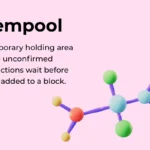
The mempool, short for memory pool, is where a Bitcoin node keeps valid transactions that it has received but that have not yet been included in a block.
There is not one single global mempool shared identically by every Bitcoin node. Each node maintains its own collection of unconfirmed transactions, and the contents can differ.
Transactions compete for limited block space. Miners generally have an economic incentive to prioritize transactions offering higher fees relative to their virtual size.
This creates a fee market. When demand for block space increases, transactions offering lower fee rates may wait longer.
4. A Miner Includes the Transaction in a Block
A miner selects transactions from its available mempool and builds a candidate block.
The miner then performs Proof of Work to find a valid block hash. When a valid block is discovered and accepted by the network, transactions included in it receive their first confirmation.
The transaction is now recorded in the blockchain, although additional confirmations may still be required by the recipient.
5. Additional Blocks Increase Settlement Confidence
Every subsequent block adds another confirmation to the transaction.
For example, a payment that initially has one confirmation will have two after the next block is accepted, three after another, and so on.
This layered confirmation process makes reversing a transaction increasingly difficult because an attacker would need to overcome the accumulated proof of work.
Seven Factors That Affect Bitcoin Transaction Time
Bitcoin transaction speed is not determined by a single factor. Several technical and market conditions influence how quickly a payment receives its first confirmation.
1. Bitcoin Network Congestion
Network congestion occurs when demand for block space exceeds the capacity available in newly produced blocks.
Bitcoin blocks have a limited weight capacity. When many users are sending transactions simultaneously, the number of pending transactions can increase.
Miners generally select transactions according to the economic value of including them, which means transactions with more competitive fee rates may receive priority.
During periods of heavy demand, a transaction with a low fee rate can remain unconfirmed for an extended period.
However, a large mempool does not automatically mean every transaction will be delayed. The fee rate offered relative to competing transactions is an important part of the picture.
2. Bitcoin Transaction Fee
The transaction fee is one of the most important factors affecting confirmation priority.
Bitcoin fees are commonly discussed in satoshis per virtual byte, written as sat/vB. A satoshi is the smallest unit of Bitcoin:
1 BTC = 100,000,000 satoshis.
The fee rate measures the fee paid relative to the transaction’s virtual size. A transaction that occupies more block space generally requires a larger total fee to achieve the same fee rate as a smaller transaction.
For example:
| Transaction | Virtual size | Fee rate | Total fee |
| A | 150 vB | 10 sat/vB | 1,500 sats |
| B | 150 vB | 30 sat/vB | 4,500 sats |
| C | 250 vB | 10 sat/vB | 2,500 sats |
The calculation is:
Total transaction fee = Virtual size × Fee rate.
A higher fee rate can make a transaction more attractive to miners, particularly when block space is in high demand. However, paying a high fee does not guarantee inclusion in a particular block.
Bitcoin.org explains that transaction fees vary with demand for block space and help compensate miners for processing transactions.
Source: Bitcoin.org – Transaction Fees.
3. Transaction Size and Complexity
Not all Bitcoin transactions occupy the same amount of block space.
A transaction’s virtual size depends on factors such as the number of inputs, the number of outputs, and the script types involved.
A transaction spending several small UTXOs may be larger than one spending a single UTXO. More inputs generally require more data and signatures, which can increase transaction size.
Because miners consider fee rates rather than simply the total fee amount, a larger transaction may need a higher total fee to compete at the same sat/vB rate.
This is why two transactions transferring the same amount of Bitcoin can have different network fees and confirmation prospects.
4. Time of Network Activity
Bitcoin operates continuously. There are no banking hours, weekends, or public holidays that stop the blockchain from processing transactions.
Nevertheless, network demand changes over time. When more users compete for limited block space, fee rates can rise and lower-fee transactions may wait longer.
The relevant factor is not simply whether a payment is sent during the day or at night. It is the current level of demand and the fee market when miners select transactions.
Checking current fee estimates before broadcasting a transaction can help users avoid choosing a fee that is too low for their desired confirmation target.
5. Miner Transaction Selection
Miners decide which eligible transactions to include in their candidate blocks.
They generally seek to maximize the fees earned from the available block space. Consequently, transactions with attractive fee rates are more likely to be selected before lower-paying alternatives.
This does not mean miners follow one universal queue. Different miners may have different mempool contents and transaction-selection policies.
As a result, the order in which transactions were broadcast does not necessarily determine the order in which they are confirmed.
6. Wallet Fee Estimation
Bitcoin wallets often estimate a suitable fee based on recent network activity and the user’s desired confirmation target.
For example, a wallet may offer a faster option with a higher fee and a more economical option with a lower fee.
These estimates are not guaranteed. Network demand can change between the moment a transaction is created and the moment a miner selects it.
Bitcoin Core provides an estimated smartfee function that estimates the fee rate required to begin confirmation within a specified number of blocks, where possible.
Source: Bitcoin Core – estimatesmartfee Documentation.
7. Confirmation Requirements of the Receiving Platform
A transaction can be confirmed on the blockchain but still remain unavailable for withdrawal or use on an exchange.
This happens because platforms establish their own deposit-crediting policies.
One exchange may credit a deposit after one confirmation, while another may require three, six, or more confirmations depending on its risk controls.
The blockchain confirmation time and the platform’s deposit-processing time should therefore be treated as separate stages.
Users should check the receiving service’s official deposit requirements rather than assuming that every Bitcoin payment becomes available after the first confirmation.
How Long Does a Bitcoin Transaction Take With Different Confirmation Levels?
The number of confirmations required determines how long a recipient may need to wait after the transaction is first included in a block.
The following estimates use Bitcoin’s average 10-minute block interval. They are approximate, not guaranteed deadlines.
| Confirmations | Approximate time from first block interval | Typical interpretation |
| 0 | No confirmed block yet | Broadcast but unconfirmed |
| 1 | Around 10 minutes | Included in a block |
| 2 | Around 20 minutes | One additional block |
| 3 | Around 30 minutes | Greater confirmation depth |
| 6 | Around 60 minutes | Traditional higher-security benchmark |
| 12 | Around 120 minutes | Deeper confirmation history |
These are simplified estimates from the time a transaction is broadcast under favorable conditions. They do not include any additional time spent waiting in the mempool before the first block includes the transaction.
The six-confirmation estimate is often misunderstood. Six confirmations do not mean that a transaction always takes exactly one hour. If the first confirmation arrives after 25 minutes, for example, five additional average block intervals could bring the total to roughly 75 minutes.
The actual waiting time depends on block discovery and the recipient’s confirmation policy.
Why Is My Bitcoin Transaction Taking So Long?
A pending Bitcoin transaction does not necessarily indicate that the funds have disappeared or that the payment has failed.
Several issues can explain a delay.
The Transaction Fee Is Too Low
If the fee rate is below what miners are currently prioritizing, the transaction may remain in the mempool while higher-fee transactions are selected.
This is especially common when network demand rises after a transaction has been broadcast.
A fee that appeared reasonable when the transaction was created may become less competitive if the mempool grows quickly.
The Mempool Is Busy
When many transactions are competing for block space, lower-fee transactions may have to wait.
A useful way to investigate this situation is to check the transaction’s fee rate against current mempool conditions using a reputable block explorer or fee estimator.
The Wallet Has Not Updated Its Status
Sometimes the transaction has already been broadcast or even confirmed, but the wallet application has not refreshed its displayed status.
This can happen because of delayed synchronization, connectivity problems, or issues with the wallet provider’s backend.
Checking the transaction ID on an independent block explorer can help establish whether the transaction is visible and whether it has received confirmations.
The Transaction Has Not Been Broadcast Successfully
A transaction that has not reached the Bitcoin network cannot be confirmed.
If the wallet shows a pending or processing message but provides no transaction ID, check whether the transaction was actually broadcast. Some services may delay broadcasting while completing internal checks.
The Transaction Is Waiting on an Unconfirmed Parent
Some transactions depend on earlier unconfirmed transactions. These are known as parent-child transaction relationships.
If a parent transaction has not been confirmed, a dependent transaction may also remain delayed. Miners can evaluate related transactions together under fee-bumping mechanisms such as Child Pays for Parents (CPFP).
How to Speed Up a Slow Bitcoin Transaction
Once a transaction has been broadcast, the sender cannot simply force a miner to include it. However, certain Bitcoin mechanisms can help improve its chances of confirmation.
The available options depend on the wallet, transaction structure, and network conditions.
1. Use Replace-by-Fee (RBF)
Replace-by-Fee allows a sender to replace an eligible unconfirmed transaction with a new transaction that pays a higher fee.
The replacement spends the same inputs but offers a more attractive fee rate. If accepted under the applicable relay and replacement rules, it can improve the likelihood of miner inclusion.
RBF is useful when the original transaction was created with a fee that is no longer competitive.
However, support and implementation depend on the wallet and transaction conditions. Users should check their wallet’s documentation before attempting a replacement.
Further reading: Blockstream – What Is Replace-by-Fee?.
2. Use Child Pays for Parent (CPFP)
Child Pays for Parents is another fee-bumping technique.
In this approach, the sender creates a new transaction that spends an output from the unconfirmed parent transaction and attaches a sufficiently attractive fee.
A miner evaluating the related transactions can consider the combined fee rate. This may make the parent and child transactions more attractive to include together.
CPFP can be useful when RBF is unavailable or when the recipient controls an output that can be spent to create the child transaction.
It is important to understand the additional fee and wallet requirements before using this method.
3. Check Current Bitcoin Fee Estimates
Before sending a new transaction, review current fee estimates.
A wallet’s fee recommendation or a reputable mempool explorer can help identify fee rates associated with different confirmation targets.
Bitcoin Core’s fee estimation documentation describes how the software estimates the approximate fee rate needed to begin confirmation within a specified number of blocks.
Remember that an estimate is not a promise. A sudden increase in network demand can change the fee market.
4. Contact the Exchange or Wallet Provider
If the transaction was sent through an exchange or custodial wallet, contact its support team when the payment appears stuck.
The service may be able to clarify whether the transaction has been broadcast, whether it is waiting for confirmation, or whether an internal processing step is involved.
Do not send another payment simply because the first one is taking longer than expected. First establish the status of the original transaction to avoid accidentally paying twice.
What Happens If a Bitcoin Transaction Remains Unconfirmed for Hours or Days?
A transaction that remains unconfirmed for an extended period may eventually be dropped from the mempool maintained by individual nodes.
This does not mean that the Bitcoin has been destroyed.
If a transaction is not confirmed, its inputs have not been permanently spent on the accepted blockchain. Depending on the wallet and the reason for the delay, the funds may become available to spend again once the transaction is no longer being tracked by relevant nodes.
However, mempool behavior is not identical across every node. A transaction may disappear from one node’s mempool while remaining visible elsewhere.
A transaction may also confirm later if a miner includes it in a block while it is still available to that miner.
Before attempting another payment, check the transaction ID and confirm its current status. If the transaction is still pending, consider whether RBF or CPFP is appropriate and supported by the wallet.
For more complex cases, the wallet provider’s guidance is preferable to attempting an unfamiliar recovery method.
How to Check the Status of a Bitcoin Transaction
A Bitcoin transaction ID, also called a transaction hash or TXID, allows users to look up a transaction on a blockchain explorer.
The TXID is a unique identifier associated with the transaction. It can usually be found in the wallet’s transaction history or payment details.
To check the status:
- Open the wallet or exchange account from which the payment was sent.
- Locate the relevant transaction in the transaction history.
- Copy its transaction ID.
- Open a reputable Bitcoin block explorer.
- Search for the TXID.
- Review the transaction’s confirmation status, fee rate, and block information.
The explorer may show whether the transaction is unconfirmed, the block in which it was included, and the number of confirmations it has accumulated.
Avoid sharing private keys, wallet recovery phrases, or passwords with anyone claiming to help track a transaction. A TXID is sufficient for a public blockchain lookup.
Bitcoin Transaction Time: On-Chain Bitcoin vs. Lightning Network
Bitcoin’s base blockchain is not the only way to make payments using the Bitcoin ecosystem.
The Lightning Network is a Layer 2 payment protocol designed to support faster, lower-cost Bitcoin payments through payment channels.
Unlike a conventional on-chain payment, a Lightning payment does not require every individual payment to be recorded in a new Bitcoin block. The channel system allows participants to make payments through a network of channels, while the underlying Bitcoin blockchain is used for channel funding and settlement.
This can make Lightning payments suitable for smaller, frequent transactions where waiting for an on-chain confirmation would be inconvenient.
However, Lightning payments have their own requirements and limitations. Successful routing depends on factors such as channel liquidity, routing availability, and network conditions. A Lightning payment is not the same process as a standard Bitcoin on-chain transaction.
| Feature | Bitcoin on-chain transaction | Lightning Network payment |
| Processing method | Recorded in a Bitcoin block | Routed through payment channels |
| Typical speed | First confirmation averages around 10 minutes | Often completes in seconds when routing succeeds |
| Fees | Depends on transaction size and block-space demand | Usually lower for suitable payments |
| Blockchain recording | Individual transaction recorded on-chain | Individual payments generally do not require a new on-chain transaction |
| Common use | Transfers, exchange deposits, settlement | Smaller and frequent payments |
The two systems serve different purposes. On-chain Bitcoin remains important for blockchain settlement and transfers, while Lightning is designed to make everyday payments more practical.
Is a Bitcoin Transaction Faster Than a Bank Transfer?
Bitcoin and traditional bank transfers use different processing systems, so comparing their speed requires considering the type of payment.
Some domestic bank transfers are processed almost instantly through real-time payment infrastructure. Other transfers, particularly international bank payments, may take longer because of banking hours, intermediary institutions, compliance checks, and settlement arrangements.
Bitcoin operates continuously and does not require a central bank or payment company to approve each on-chain transaction. However, its confirmation process is tied to block production, and recipients may require multiple confirmations.
The comparison also depends on whether the user is measuring notification time, usable funds, or final settlement.
A Bitcoin payment may appear in a wallet quickly but still need confirmations. Similarly, a bank may show a transfer notification before all settlement processes are complete.
Therefore, it is more accurate to compare specific payment routes and settlement requirements than to claim that Bitcoin is always faster or slower than banks.
How Many Bitcoin Confirmations Are Enough?
There is no single confirmation requirement that applies to every Bitcoin transaction.
The appropriate number depends on the payment amount, the risk of double spending, the recipient’s policies, and the level of settlement confidence required.
For small payments, a recipient may decide that one confirmation is sufficient. A merchant accepting a higher-value payment may prefer to wait for additional confirmations. Cryptocurrency exchanges often establish their own deposit confirmation thresholds.
Six confirmations are a widely recognized traditional benchmark because they represent several additional blocks of proof of work after the transaction’s inclusion.
However, six confirmations should not be treated as a mathematical guarantee that reversal is impossible. Bitcoin transactions become increasingly difficult to reverse as confirmations accumulate, but the security assessment depends on the threat model and network conditions.
For businesses, it is sensible to define confirmation policies based on transaction value and operational risk rather than applying one threshold to every payment.
Common Bitcoin Transaction Myths Explained
Myth 1: Every Bitcoin Transaction Takes Exactly 10 Minutes
This is incorrect. Ten minutes is the target average interval between blocks, not a fixed transaction processing time. A transaction may be confirmed sooner or much later.
Myth 2: A Payment Is Final as Soon as It Appears in a Wallet
A wallet notification may represent an unconfirmed transaction. It does not necessarily mean that a miner has included the payment in a block.
Myth 3: Paying a Higher Fee Guarantees Immediate Confirmation
A competitive fee rate can improve a transaction’s priority, but miners still decide which transactions to include. Block discovery is also probabilistic, so no fee guarantees confirmation at an exact time.
Myth 4: Bitcoin Transactions Can Always Be Cancelled
Once a transaction has been broadcast, it cannot be cancelled in the same way as a pending bank transfer. Some unconfirmed transactions can be replaced using RBF, but this depends on transaction and wallet support. Confirmed transactions are not ordinarily reversible through a simple cancellation process.
Myth 5: An Unconfirmed Transaction Means Bitcoin Is Lost
An unconfirmed transaction has not yet been recorded in a confirmed block. It may still confirm, be replaced, or eventually be dropped from mempools. The correct response is to check its status rather than assume the funds have disappeared.
Practical Tips for Faster and More Reliable Bitcoin Payments
Users can reduce avoidable delays by preparing transactions carefully and understanding the fee market.
First, check the current fee estimate before sending. A fee rate selected during quiet network conditions may be insufficient if demand rises.
Second, review the transaction details before broadcasting. Confirm the recipient address, amount, and fee. Bitcoin transactions are generally irreversible after confirmation, so address accuracy matters.
Third, avoid unnecessarily complex transactions when possible. Spending many small UTXOs can increase transaction size and the total fee required.
Fourth, use a wallet that provides clear transaction status information and supports appropriate fee-management features such as RBF when available.
Finally, if the recipient needs a fast payment for a small everyday purchase, consider whether a Lightning payment is supported by both parties. For an exchange deposit or a transaction requiring on-chain settlement, use the Bitcoin network and follow the recipient’s confirmation requirements.
The Future of Bitcoin Transaction Speed
Bitcoin’s transaction speed is a continuing subject of development and debate.
The base layer prioritizes decentralization, security, and predictable monetary rules rather than attempting to process an unlimited number of transactions in every block. Its limited block space creates a fee market, especially during periods of high demand.
Several approaches aim to improve the user experience without changing the basic purpose of the base layer.
The Lightning Network supports off-chain payments through payment channels. Wallet improvements can make fee selection and transaction management easier. Other developments in Bitcoin software and infrastructure can improve how nodes handle transactions and how users interact with the network.
These approaches do not remove every limitation. Lightning requires suitable channel liquidity and routing, while on-chain transactions continue to depend on block space and miner selection.
The most useful way to think about Bitcoin scalability is therefore as a combination of base-layer settlement and additional payment infrastructure, rather than expecting every transaction to be confirmed instantly on the main blockchain.
Conclusion: How Long Should You Expect a Bitcoin Transaction to Take?
A Bitcoin transaction typically receives its first confirmation in approximately 10 minutes, based on the network’s average block interval. However, the actual waiting time depends on fee rate, mempool demand, transaction size, and block discovery.
A transaction may appear in a wallet within seconds but remain unconfirmed until a miner includes it in a block. After that, additional confirmations increase confidence in the payment’s settlement. Six confirmations are often used as a traditional benchmark for higher-value transactions, although individual services may require different thresholds.
If a payment is delayed, check its TXID, review the fee rate, and determine whether it is still in the mempool. Depending on wallet support, RBF or CPFP may help improve the transaction’s confirmation prospects.
Understanding the difference between broadcast time, first confirmation, and settlement confidence helps users make better decisions when sending, receiving, and managing Bitcoin.
Frequently Asked Questions (FAQs)
1. How long does a Bitcoin transaction usually take?
A Bitcoin transaction typically receives its first confirmation in around 10 minutes on average. However, the actual time can vary depending on network demand, transaction fee rate, and when a miner includes it in a block.
2. Can a Bitcoin transaction take 24 hours?
Yes. A transaction can remain unconfirmed for 24 hours or longer, particularly when it has a low fee rate compared with competing transactions. A long delay does not automatically mean the funds are lost. Check the transaction ID and its current status before taking further action.
3. Why is my Bitcoin transaction still unconfirmed?
Common reasons include a low transaction fee, high demand for block space, a large transaction size, or an issue with the wallet’s broadcast process. Check whether the transaction appears on a block explorer and review its fee rate and confirmation status.
4. Does a higher Bitcoin transaction fee make it faster?
A higher fee rate can make a transaction more attractive to miners and improve its chances of being included in an earlier block. However, it does not guarantee immediate confirmation because block production and miner selection are not fully predictable.
5. How many confirmations does Bitcoin need?
There is no universal requirement. One confirmation means the transaction has been included in a block, while six confirmations are commonly used as a traditional higher-security benchmark. Exchanges and payment services may apply their own requirements.
6. How long do six Bitcoin confirmations take?
Using the average block interval of approximately 10 minutes, six confirmations are commonly estimated at around 60 minutes. Actual time varies because individual blocks are not produced at exact 10-minute intervals.
7. Can I speed up an unconfirmed Bitcoin transaction?
In some cases, yes. Replace-by-Fee (RBF) can allow an eligible transaction to be replaced with one offering a higher fee. Child Pays for Parents (CPFP) can use a related transaction with a higher combined fee rate to encourage miners to include both transactions. Wallet support and transaction conditions matter.
8. Can I cancel a Bitcoin transaction that is pending?
Bitcoin does not provide a universal cancellation function. Some unconfirmed transactions may be replaced through RBF if the wallet and transaction support it. Once a transaction is confirmed, it cannot ordinarily be cancelled or reversed through the blockchain.
9. Is a Bitcoin transaction complete after one confirmation?
One confirmation means the transaction has been included in a valid block. It provides meaningful protection, but additional confirmations increase confidence that the transaction will not be reversed. Whether one confirmation is sufficient depends on the payment amount and the recipient’s risk policy.
10. Is the Lightning Network faster than Bitcoin?
Lightning payments can often complete in seconds when a suitable payment route and sufficient liquidity are available. They use payment channels rather than requiring each individual payment to be confirmed in a new Bitcoin block. They are useful for many smaller payments but have different technical requirements from on-chain transactions.
11. Do Bitcoin transactions process on weekends?
Yes. The Bitcoin network operates continuously, including weekends and public holidays. It does not depend on traditional banking hours. Transaction confirmation still depends on block production and available block space.
12. What happens if my Bitcoin transaction disappears from the mempool?
A transaction may be removed from a particular node’s mempool if it remains unconfirmed or no longer meets that node’s policies. Mempools can differ between nodes, so disappearance from one explorer does not prove that every node has dropped it. Check the TXID and consult the wallet provider before attempting another payment.
13. Can a Bitcoin transaction be confirmed in less than 10 minutes?
Yes. The 10-minute figure is an average block interval, not a minimum waiting period. If a miner finds a block shortly after a transaction is broadcast and includes it, the transaction can receive its first confirmation in less than 10 minutes.
14. Why does my Bitcoin deposit show as confirmed but remain unavailable on an exchange?
The exchange may require additional blockchain confirmations or may have a separate deposit-processing procedure. Check the platform’s official deposit requirements and distinguish blockchain confirmation status from the exchange’s internal crediting process.
15. Where can I track a Bitcoin transaction?
You can track a Bitcoin transaction using its transaction ID (TXID) on a reputable Bitcoin block explorer. The explorer can show whether the transaction is unconfirmed, the block containing it, and its current confirmation count. Never provide your private keys or recovery phrase to someone offering to track a transaction.
If you want to contribute your piece of content on Crypto, Bitcoins and other digital currencies for Bitsat, You can search for us in Google with queries like “write for us crypto”. “Write for us bitcoins” or directly contact us and let us know what you want.