
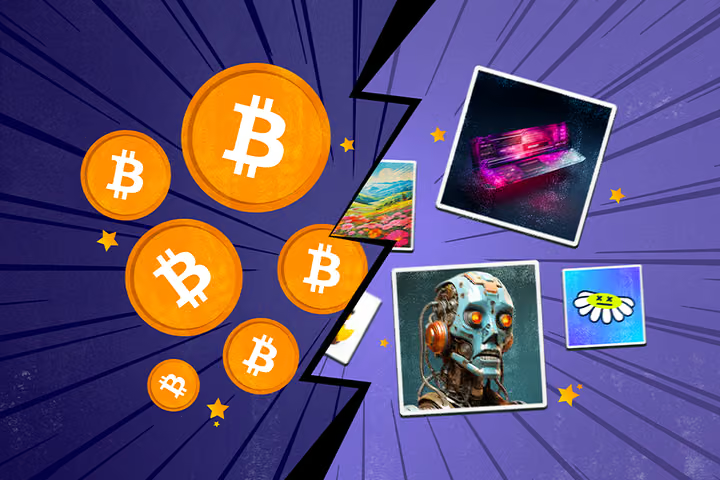
Bitcoin Ordinals and NFTs are often discussed as if they are completely separate technologies. In reality, they overlap significantly: both can represent unique digital collectibles, artwork, media, memberships, game assets, and other digital items. The important difference is how those assets are identified, recorded, transferred, and connected to blockchain infrastructure.
- Bitcoin Ordinals vs NFTs at a Glance
- What Are Bitcoin Ordinals?
- What Are Bitcoin Inscriptions?
- How Do Bitcoin Inscriptions Work?
- What Is an NFT?
- Bitcoin Ordinals vs NFTs: The Fundamental Difference
- Ordinals Are Not Simply “NFTs on Bitcoin”
- On-Chain Storage: One of the Biggest Differences
- How Big Can Bitcoin Inscriptions Be?
- Current Scale of the Ordinals Ecosystem
- Why Bitcoin Ordinals Became Important for Digital Collectibles
- Ordinals vs Ethereum NFTs: Ownership Models
- Smart Contracts: Bitcoin Ordinals vs NFTs
- Programmability and Composability
- Metadata and Permanence
- Transaction Fees and Block Space
- Bitcoin Ordinals and NFT Rarity
- Are Bitcoin Ordinals More Permanent Than NFTs?
- Security Considerations
- Bitcoin Ordinals vs NFTs for Developers
- Bitcoin Ordinals vs NFTs for Businesses
- Ordinals vs NFTs: Which Technology Should You Use?
- What About Bitcoin Ordinals and BRC-20?
- Ordinals and NFTs: The Role of Marketplaces
- What the Data Says About Bitcoin Inscriptions
- Bitcoin Ordinals vs NFTs: Key Takeaways
- Final Perspective
- Is an Ordinal an NFT?
- What is the difference between an Ordinal and an inscription?
- Are Bitcoin Ordinals stored on-chain?
- Are Ethereum NFTs stored completely on-chain?
- Do Bitcoin Ordinals require smart contracts?
- Can Ordinals contain images?
- Can an Ordinal contain video or audio?
- What makes a satoshi rare?
- Can an Ordinal be transferred like Bitcoin?
- What is ERC-721?
- Are Ordinals more permanent than NFTs?
- Do Bitcoin Ordinals have smart contracts?
- Can businesses build marketplaces for Bitcoin Ordinals?
- Are Bitcoin Ordinals only for digital art?
- Bitcoin Ordinals vs NFTs: Which one should a business choose?
Bitcoin Ordinals use ordinal theory to assign identities to individual satoshis, the smallest units of Bitcoin. An inscription can then attach arbitrary digital content to a particular satoshi. The resulting asset is commonly described as a Bitcoin NFT or Bitcoin-native digital artifact.
Traditional NFTs, meanwhile, are blockchain-based non-fungible tokens generally implemented through token standards such as Ethereum’s ERC-721 or ERC-1155. In an ERC-721 system, each NFT is identified by the combination of a smart contract address and a unique token ID.
That distinction creates meaningful differences in ownership models, metadata, programmability, storage, wallets, marketplaces, transaction design, and application development.
This guide explains Bitcoin Ordinals vs NFTs from the technical foundation upward, so developers, collectors, businesses, and Web3 users can understand where the two models overlap and where they fundamentally differ.
Bitcoin Ordinals vs NFTs at a Glance
The simplest way to understand the relationship is this:
- An NFT is a category of unique blockchain-based digital asset.
- An Ordinal is a Bitcoin-specific numbering system for individual satoshis.
- An inscription is digital content attached to a satoshi using the Ordinals protocol.
- A Bitcoin inscription can function as an NFT-like collectible, but Ordinals are not limited to NFTs.
- Ethereum NFTs commonly rely on smart contracts and token standards such as ERC-721.
- Bitcoin inscriptions use Bitcoin transactions and Taproot-based inscription mechanisms rather than a conventional NFT smart contract.
- Ethereum NFTs can use external or decentralized storage for media and metadata, whereas inscription content can be stored directly on Bitcoin’s blockchain.
- Ordinals inherit Bitcoin’s UTXO transaction model, while conventional NFTs generally use account-based smart-contract state on chains such as Ethereum.
So, “Ordinals vs NFTs” is technically not a perfect apples-to-apples comparison. Ordinals describe a Bitcoin protocol concept, while NFT describes a broader asset type.
What Are Bitcoin Ordinals?
Bitcoin Ordinals are a system for assigning individual identities to satoshis and tracking their movement through Bitcoin transactions.
One bitcoin contains 100,000,000 satoshis. Ordinal theory assigns numbers to those satoshis according to the order in which they are mined and provides rules for tracking them as they move between transaction inputs and outputs.
The key idea is that while Bitcoin normally treats satoshis as interchangeable units of currency, ordinal theory gives individual satoshis a distinct identity.
For example, two satoshis can have different ordinal numbers even though both are worth exactly 0.00000001 BTC as monetary units.
Ordinal theory also introduces a concept of satoshi rarity. The Ordinal Theory Handbook categorizes satoshis as common, uncommon, rare, epic, legendary, or mythic based on their position relative to Bitcoin blocks, difficulty adjustments, halvings, cycles, and the genesis block.
The theoretical supply of the rarest categories is extremely small. The Ordinal Theory Handbook lists 3,432 rare sats, 27 epic sats, 5 legendary sats, and 1 mythic sat in its rarity framework.
This rarity concept creates a collecting dimension that does not exist in the same way with conventional Ethereum NFTs.
What Are Bitcoin Inscriptions?
An inscription is digital content attached to a particular satoshi.
That content can include images, text, HTML, SVG, audio, video, or other arbitrary data. The Ordinals documentation describes inscriptions as Bitcoin-native digital artifacts and notes that inscriptions do not require a sidechain or separate token.
The important distinction is:
Ordinal = the identification and tracking system for satoshis.
Inscription = content attached to a satoshi using that system.
This means an Ordinal itself is not necessarily an NFT. An inscription may be used as an NFT-like collectible, but the underlying system can support other types of digital artifacts and applications.
The inscription model also supports concepts such as parent-child relationships, metadata, provenance, delegation, recursion, and reinscriptions.
That makes the Ordinals ecosystem broader than simply “Bitcoin pictures.”
How Do Bitcoin Inscriptions Work?
Bitcoin inscriptions use Bitcoin’s existing transaction architecture together with Taproot.
The inscription process generally uses two transactions:
- A commit transaction creates a Taproot output committing to the inscription data.
- A reveal transaction spends that output and reveals the inscription content on-chain.
The Ordinals documentation describes inscription content as being placed in Taproot script-path spend data using an inscription envelope.
This matters because the content is not merely a web link pointing to an image stored somewhere else. The inscription model is designed to place the content itself on Bitcoin’s blockchain.
The Ordinals handbook states that inscription content is stored on-chain in Taproot script-path spend scripts.
That gives Bitcoin inscriptions a distinctive persistence model.
However, “on-chain” does not automatically mean that every component of every Ordinals-based project is decentralized. A marketplace, wallet interface, collection website, indexing service, or trading platform can still introduce centralized dependencies.
That distinction is important for accurate Web3 analysis.
What Is an NFT?
NFT stands for non-fungible token.
A fungible asset is interchangeable with another unit of the same asset. For example, one unit of a standard fungible token can generally be exchanged for another identical unit.
A non-fungible token is different because each token can be individually identified.
Ethereum’s ERC-721 standard provides a widely used framework for NFTs. Each ERC-721 token is uniquely identified within its smart contract, and the combination of contract address and token ID creates a globally unique identifier for that asset on the Ethereum chain.
ERC-721 also provides standardized functions for ownership, transfers, approvals, and other NFT operations.
Ethereum additionally supports ERC-1155, a multi-token standard capable of representing both fungible and non-fungible assets and supporting batch operations.
Therefore, when people say “NFT,” they are usually talking about a blockchain asset that has unique identity and ownership rather than a particular blockchain technology.
Bitcoin Ordinals vs NFTs: The Fundamental Difference
The biggest difference is the underlying asset model.
A conventional Ethereum NFT is typically a token represented by a smart contract.
A Bitcoin inscription is digital content associated with an individual satoshi through ordinal theory.
In simplified terms:
| Feature | Bitcoin Ordinals / Inscriptions | Conventional NFTs |
| Primary blockchain example | Bitcoin | Ethereum and other smart-contract chains |
| Underlying concept | Individual satoshi + inscription | Unique token controlled by smart contract |
| Asset identifier | Inscription ID and associated satoshi | Contract address + token ID |
| Smart contract required | No | Commonly yes |
| Content storage | Can be directly on Bitcoin | Often metadata/content referenced through URI or storage system |
| Native transaction model | Bitcoin UTXO | Commonly account-based |
| Programmability | More limited at Bitcoin script level | Extensive through smart contracts |
| Token standards | No ERC-721 equivalent required | ERC-721, ERC-1155 and other standards |
| Satoshi rarity | Can be relevant | Not applicable |
| Bitcoin-native | Yes | No, unless NFT exists on Bitcoin |
| Typical use cases | Collectibles, art, inscriptions, provenance, experimental applications | Art, gaming, memberships, collectibles, tickets, digital assets |
This table should not be interpreted as meaning that every NFT uses Ethereum or every Ordinal is an NFT. Both ecosystems are broader than these simplified examples.
Ordinals Are Not Simply “NFTs on Bitcoin”
Calling Ordinals “Bitcoin NFTs” can be useful for beginners because it explains the collectible aspect quickly.
Technically, however, the terminology can be misleading.
The Ordinals system itself is concerned with individual satoshis and their identities. Inscriptions provide a way to associate arbitrary data with those satoshis. The resulting inscription may be traded as a collectible, but the protocol is not simply an implementation of ERC-721 on Bitcoin.
The Ordinals documentation explicitly describes inscriptions as Bitcoin-native digital artifacts and explains that they can be transferred using ordinary Bitcoin transactions and UTXOs, with additional sat-control requirements for safely handling individual inscriptions.
That distinction becomes especially important for developers designing Bitcoin applications.
On-Chain Storage: One of the Biggest Differences
One of the most important differences between many Bitcoin inscriptions and conventional NFTs is where the asset’s content resides.
The ERC-721 specification provides an optional metadata extension using tokenURI. That URI can point to a JSON metadata document containing fields such as the asset’s name, description, and image.
That means a traditional NFT may have several layers:
Blockchain token → metadata URI → metadata JSON → image or media file.
Those components can be hosted using different infrastructure.
Some NFT projects use centralized web servers. Others use decentralized storage systems or content-addressed systems. Consequently, the durability of an NFT’s token ownership record does not automatically guarantee that its associated media will remain available forever.
Bitcoin inscriptions take a different approach. The inscription content itself can be stored directly on-chain in Bitcoin’s Taproot-related transaction data.
This creates a different persistence model.
However, on-chain storage also has a cost: larger content consumes block space and users must pay transaction fees associated with including that data.
How Big Can Bitcoin Inscriptions Be?
Bitcoin’s Segregated Witness design established a maximum block weight of 4,000,000 weight units. Witness data receives a different weighting under Bitcoin’s consensus rules, which is part of the technical foundation that made inscriptions practical.
The Ordinals documentation notes that inscription content uses Taproot scripts and benefits from the witness discount.
This does not mean Bitcoin provides unlimited decentralized storage.
Block space remains scarce.
A large inscription competes for block resources with Bitcoin payments and other transactions. When demand for block space rises, fees can increase.
This is one reason Bitcoin Ordinals generated substantial debate within the Bitcoin ecosystem: inscriptions introduced a new type of demand for Bitcoin block space beyond traditional monetary transfers.
Current Scale of the Ordinals Ecosystem
Ordinals are no longer a small experiment confined to a handful of early adopters.
Current blockchain data illustrates the scale of inscription activity. Ordinals.com continues to provide a live explorer for inscriptions, while Ordiscan currently reports more than 127 million inscriptions and approximately 33.9 GB of stored inscription data. It also reports cumulative inscription fees of more than 4,400 BTC. These figures are live ecosystem measurements and can change continuously, so they should be treated as current snapshots rather than permanent totals.
Glassnode’s September 2026 data also shows that inscription activity spans multiple content categories. As of September 14, 2026, its cumulative data-size metrics included more than 23.4 billion bytes of image inscription data, 5.6 billion bytes of text/BRC-20 data, 3.6 billion bytes of other text data, 242.8 million bytes of video data, and 182 million bytes of audio data.
The numbers demonstrate an important point: Bitcoin inscriptions are not exclusively an NFT-art phenomenon.
Why Bitcoin Ordinals Became Important for Digital Collectibles
Bitcoin has existed since 2009 primarily as a peer-to-peer monetary network. Historically, Bitcoin’s scripting environment was not designed around the extensive smart-contract application architecture associated with Ethereum.
Ordinals expanded the types of digital artifacts that developers and collectors could associate with Bitcoin.
The concept introduced several new possibilities:
- Bitcoin-native digital art
- collectible satoshis
- permanently recorded digital artifacts
- on-chain media
- provenance systems
- generative inscription techniques
- parent-child inscription relationships
- recursive inscriptions
- experimental decentralized applications
- token and asset protocols built around Bitcoin transaction data
The Ordinals handbook documents recursion, delegation, provenance, metadata, parent-child inscriptions, and other mechanisms that go beyond simple image storage.
This makes Ordinals particularly interesting from a blockchain development perspective.
Ordinals vs Ethereum NFTs: Ownership Models
Ownership is another major technical distinction.
Bitcoin uses the UTXO model. Bitcoin transactions consume previous unspent transaction outputs and create new outputs. The Bitcoin developer documentation explains that a UTXO can only be spent once and that transaction outputs subsequently become inputs to later transactions.
An inscription is associated with a satoshi moving through that transaction system.
That creates an unusual requirement: wallets must understand how to control the relevant satoshi and avoid accidentally spending an inscription as ordinary BTC.
The Ordinals wallet documentation specifically warns that wallets need sat-control and sat-selection capabilities to safely manage inscriptions and rare satoshis.
Ethereum NFTs work differently. ERC-721 contracts maintain ownership information within smart-contract states and provide standardized functions such as ownerOf, transferFrom, and safeTransferFrom.
For application developers, this distinction affects wallet architecture, transaction construction, indexing, marketplace logic, and asset-management workflows.
Smart Contracts: Bitcoin Ordinals vs NFTs
Smart-contract architecture is one of the clearest differences.
A typical Ethereum NFT collection uses a smart contract that defines how tokens are created, transferred, identified, and sometimes modified.
The contract may also include additional application logic such as:
- minting rules
- royalties
- allowlists
- staking
- burning
- access control
- dynamic attributes
- marketplace interactions
- game mechanics
- membership functionality
ERC-721 provides standardized NFT functionality, while developers can build additional logic on top of the standard.
Bitcoin inscriptions do not require an NFT smart contract in the same sense.
Instead, they rely on Bitcoin’s transaction and scripting infrastructure plus ordinal interpretation.
This can reduce the smart-contract surface area for a simple digital collectible, but it also means developers cannot assume the same programmable environment available on Ethereum.
For applications requiring complex state transitions, automated financial logic, decentralized exchanges, lending, or composable application behavior, the differences become significant.
Programmability and Composability
Ethereum’s smart-contract environment makes NFTs highly composable.
An NFT can interact with another smart contract, be used as collateral in a protocol, grant access to an application, represent a game asset, or trigger another on-chain function.
For example, an NFT marketplace can call standardized contract functions to transfer tokens after payment conditions are satisfied.
Bitcoin inscriptions have a different model.
Bitcoin Script is intentionally more constrained than a general-purpose smart-contract platform such as Ethereum. Ordinals can support sophisticated inscription functionality, but they do not transform Bitcoin into an Ethereum-style smart-contract environment.
This is an important distinction for companies considering NFT development.
If the goal is a digital collectible with Bitcoin-native provenance and on-chain content, Ordinals may be relevant.
If the goal is a highly composable application in which NFTs interact with multiple smart contracts, lending protocols, games, DAOs, or complex DeFi systems, a smart-contract blockchain may provide a different technical architecture.
Metadata and Permanence
Metadata is another area where “NFT” and “Ordinal” implementations can differ substantially.
In an ERC-721 project, the token contract can expose a URI for metadata. The metadata may contain the image, attributes, description, animation URL, and other information. The ERC-721 standard explicitly allows metadata to be associated through a URI.
The URI itself may point to centralized or decentralized infrastructure.
By contrast, an inscription can put its content directly on Bitcoin.
This can provide strong content persistence characteristics, but it does not eliminate every dependency. Applications still require indexing, wallets, marketplaces, interfaces, and software capable of interpreting inscription data.
Therefore, “fully on-chain” and “fully decentralized application” should not be treated as identical claims.
Transaction Fees and Block Space
Both Ordinals and NFTs incur blockchain-related costs, but the cost structures differ.
For Bitcoin inscriptions, the amount of inscription data directly affects transaction size and therefore the fee required to obtain block inclusion under prevailing fee-market conditions.
The Ordinals documentation notes that inscription content contributes directly to transaction weight, with one byte of inscription content costing one weight unit in the relevant inscription transaction context. It also recommends keeping inscription transactions below the relay limit.
Ethereum NFT transactions use gas rather than Bitcoin’s satoshi-per-byte fee model.
Ethereum users may pay gas for minting, transferring, approving, or interacting with NFT contracts.
Therefore, comparing “Bitcoin Ordinals fees vs NFT fees” requires specifying the blockchain, transaction type, network conditions, data size, and application architecture.
There is no permanent universal fee advantage.
Bitcoin Ordinals and NFT Rarity
Rarity works differently in the two ecosystems.
Traditional NFT collections can assign rarity based on traits.
For example, a collection might contain 10,000 NFTs and classify attributes such as background, clothing, accessories, or character type according to statistical rarity.
Ordinal collectibles can also have collection-based trait rarity, but Bitcoin introduces another dimension: satoshi rarity.
The Ordinals framework identifies rarity based on Bitcoin’s protocol events. A first satoshi of a block can be categorized as uncommon; a satoshi associated with the first block of a difficulty adjustment period can be rare; a satoshi associated with the first block of a halving epoch can be epic; and so forth.
This means an inscription’s perceived scarcity can be influenced by both the digital content and the historical characteristics of the satoshi carrying it.
That is a distinctive feature of Bitcoin Ordinals.
Are Bitcoin Ordinals More Permanent Than NFTs?
There is no technically correct universal answer that applies to every NFT.
The better question is: where is the asset’s content stored, and what dependencies are required to retrieve it?
A Bitcoin inscription whose content is directly stored on-chain has a different persistence model from an NFT whose token points to an image hosted on a conventional web server.
But NFTs can also use decentralized or content-addressed storage, and some NFT systems can store substantial information on-chain.
Therefore, the comparison should be made at the implementation level.
When evaluating an NFT or Ordinal project, examine:
- where the media is stored
- where metadata is stored
- whether metadata can change
- who controls the storage infrastructure
- whether the asset can be independently retrieved
- how ownership is verified
- whether a smart contract controls transfers
- whether the project depends on a centralized API
- whether marketplace infrastructure is required
This is much more meaningful than simply labeling one technology “permanent.”
Security Considerations
Bitcoin Ordinals and NFTs introduce different security considerations.
For Ordinals, users must understand sat control and UTXO management. A wallet that does not properly distinguish an inscription-bearing UTXO from ordinary BTC can create operational risks. The Ordinals documentation specifically discusses the need for sat-selection and warns about accidentally spending inscriptions.
For Ethereum NFTs, common risks include malicious approvals, compromised wallets, phishing websites, vulnerable smart contracts, counterfeit collections, and marketplace exploits.
Developers also need to consider smart-contract vulnerabilities.
In both ecosystems, private-key security remains fundamental. If a user’s wallet is compromised, blockchain immutability does not provide a mechanism for reversing unauthorized transactions.
Bitcoin Ordinals vs NFTs for Developers
The appropriate technology depends heavily on the application requirements.
A developer considering Bitcoin Ordinals should evaluate whether the application benefits from:
- Bitcoin-native settlement
- direct on-chain content
- satoshi-level identity
- Bitcoin provenance
- inscription-based collectibles
- rare-satoshi mechanics
- Bitcoin ecosystem integration
A developer building a conventional NFT application may instead prioritize:
- smart-contract programmability
- established NFT standards
- complex marketplace logic
- gaming integration
- DeFi composability
- multi-contract interactions
- programmable ownership
- established token tooling
Neither architecture automatically fits every use case.
The correct decision should start with technical requirements rather than the popularity of a particular blockchain narrative.
Bitcoin Ordinals vs NFTs for Businesses
Businesses should also distinguish between the asset layer and the application layer.
An Ordinal can provide a Bitcoin-native digital artifact, but a commercial product may still need:
- a marketplace
- wallet integration
- authentication
- payment processing
- indexing
- analytics
- collection management
- customer dashboards
- API infrastructure
- compliance workflows
- smart-contract or Bitcoin transaction development
- custody or asset-management infrastructure
Similarly, an Ethereum NFT project requires more than an ERC-721 contract.
A complete NFT product can include smart contracts, front-end applications, wallet integrations, indexing, marketplace functionality, metadata infrastructure, security audits, and analytics.
This is where blockchain development strategy becomes more important than simply selecting “Ordinals vs NFTs.”
Ordinals vs NFTs: Which Technology Should You Use?
The answer depends on the desired asset and application architecture.
Ordinals are particularly relevant when Bitcoin itself is central to the product and the project benefits from individual satoshi tracking and direct inscription-based data.
Conventional NFTs can be more appropriate when the project depends heavily on smart contracts, programmable ownership, standardized NFT interfaces, or interactions with other decentralized applications.
Some businesses may even consider a multi-chain approach.
For example, a brand could use Bitcoin inscriptions for a Bitcoin-native collectible while using an Ethereum-compatible NFT for an application requiring more complex smart-contract interactions.
The important point is that an NFT is an asset model, while Ordinals are a Bitcoin-specific protocol framework. They should not be treated as mutually exclusive concepts.
What About Bitcoin Ordinals and BRC-20?
Bitcoin Ordinals are also frequently confused with BRC-20.
They are related but not identical.
Ordinals provide the underlying numbering and inscription framework. BRC-20 is a token protocol that uses inscriptions to define and track fungible token operations.
An NFT-like inscription represents a unique digital artifact, whereas fungible token protocols attempt to represent interchangeable units.
This distinction is important because not every Bitcoin inscription represents an NFT.
Bitcoin’s inscription ecosystem has expanded into multiple asset and application categories, including fungible-token experiments, collectibles, data, and other digital artifacts.
Ordinals and NFTs: The Role of Marketplaces
Marketplaces are important for both ecosystems, but the underlying asset mechanics differ.
An NFT marketplace interacting with ERC-721 assets can use standardized smart-contract interfaces to identify ownership, transfer tokens, and process transactions.
An Ordinals marketplace must understand Bitcoin transactions, inscription IDs, satoshi locations, UTXOs, and appropriate transaction construction.
The infrastructure therefore has to account for Bitcoin’s transaction model.
The existence of an Ordinals marketplace does not change the underlying Bitcoin protocol. It provides an application layer for discovering, buying, selling, or transferring inscriptions.
Current Ordinals infrastructure includes dedicated explorers and marketplace APIs. For example, ORD.NET describes an API capable of reading order books, listing inscriptions, buying listings, and negotiating offers.
What the Data Says About Bitcoin Inscriptions
The growth of inscription activity demonstrates that the technology developed into a substantial Bitcoin data category.
Glassnode’s September 2026 data shows billions of bytes of cumulative inscription data across images, text, video, audio, and other categories.
Ordiscan’s current explorer snapshot reports more than 127 million inscriptions and more than 4,400 BTC in cumulative inscription fees.
These figures should not be interpreted as equivalent to NFT market capitalization or NFT sales volume. An inscription count includes many types of content and protocols, and individual inscriptions do not necessarily represent traded collectibles.
This is an important E-E-A-T distinction: ecosystem activity metrics must be defined before they are used to describe market adoption.
Bitcoin Ordinals vs NFTs: Key Takeaways
Bitcoin Ordinals and NFTs overlap, but they are not identical concepts.
An NFT is a non-fungible digital asset model. Ordinals are a Bitcoin-specific system for identifying and tracking individual satoshis. Inscriptions allow data to be associated with those satoshis, creating Bitcoin-native digital artifacts.
Traditional NFTs commonly rely on smart contracts such as ERC-721, which standardizes token ownership and transfers.
The most significant technical differences involve the underlying asset model, blockchain architecture, data storage, transaction design, programmability, wallet requirements, and application infrastructure.
Ordinals can be particularly distinctive because the digital artifact is associated with an individual satoshi, potentially adding satoshi rarity and historical significance to the collectible.
At the same time, conventional NFTs can provide powerful smart-contract programmability and composability.
Neither model should be reduced to a simple claim that one is universally superior. The appropriate architecture depends on whether the product needs Bitcoin-native inscriptions and satoshi-level identity or a programmable NFT environment built around smart contracts.
Final Perspective
The most useful way to understand Bitcoin Ordinals vs NFTs is not to treat them as competing definitions.
NFT describes what an asset is: a unique digital token or asset representation.
Ordinals describe a Bitcoin-native method of identifying individual satoshis, while inscriptions provide a mechanism for associating data with those satoshis.
That difference affects almost every layer of the technology stack, from storage and ownership to wallets, marketplaces, transaction construction, smart contracts, and application design.
As the Bitcoin inscription ecosystem continues to evolve, the important question for developers and businesses is not simply whether Ordinals are “Bitcoin NFTs.” It is how their technical properties can be applied to a particular digital-asset use case while accounting for Bitcoin’s transaction model, block-space constraints, wallet requirements, security considerations, and long-term infrastructure needs.
FAQs
Are Bitcoin Ordinals the same as NFTs?
No. Ordinals are a Bitcoin system for numbering and tracking individual satoshis. Inscriptions can attach digital content to those satoshis and may function as NFT-like collectibles. An NFT is a broader concept referring to a unique blockchain-based digital asset.
Is an Ordinal an NFT?
An Ordinal inscription can be used as an NFT-like digital collectible, but not every Ordinal-related asset should be described as an NFT. Ordinal theory itself concerns individual satoshis and their tracking.
What is the difference between an Ordinal and an inscription?
An Ordinal refers to the identity and tracking of an individual satoshi under ordinal theory. An inscription is attached to that satoshi. The two concepts work together but describe different layers.
Are Bitcoin Ordinals stored on-chain?
Inscription content can be stored directly on Bitcoin’s blockchain using Taproot-related transaction data. The Ordinals documentation specifically describes inscription content as on-chain.
Are Ethereum NFTs stored completely on-chain?
Not necessarily. An ERC-721 NFT can use a tokenURI to reference metadata, and that metadata can point to additional media resources. Some NFT projects use fully on-chain data, while others use external or decentralized storage.
Do Bitcoin Ordinals require smart contracts?
No. Bitcoin inscriptions do not require an Ethereum-style NFT smart contract. They use Bitcoin transactions, Taproot-related scripts, and ordinal theory.
Can Ordinals contain images?
Yes. Bitcoin inscriptions can contain arbitrary content, including image data. Current blockchain analytics show that images represent a substantial portion of cumulative inscription data.
Can an Ordinal contain video or audio?
Yes. The inscription model supports arbitrary content types, and ecosystem analytics track image, text, audio, video, and other inscription categories.
What makes a satoshi rare?
Ordinal theory defines rarity based on Bitcoin protocol events. For example, the first satoshi of a block is categorized as uncommon, while satoshis associated with difficulty adjustments, halvings, cycles, and the genesis block can fall into progressively rarer categories.
Can an Ordinal be transferred like Bitcoin?
An inscription-bearing satoshi moves through Bitcoin transactions and UTXOs, but safe handling requires appropriate sat-control and transaction construction. Users should not assume that every Bitcoin wallet will manage inscriptions correctly.
What is ERC-721?
ERC-721 is an Ethereum token standard for non-fungible tokens. It provides standardized functionality for identifying and transferring individual NFTs and can optionally expose metadata through a token URI.
Are Ordinals more permanent than NFTs?
That depends on the implementation. An inscription can store its content directly on Bitcoin, while many NFT systems reference external metadata or media. However, some NFT projects also use on-chain or decentralized storage. The correct comparison is therefore based on where the content and metadata are actually stored.
Do Bitcoin Ordinals have smart contracts?
Ordinals themselves do not require Ethereum-style smart contracts. Bitcoin Script and transaction mechanics provide the underlying infrastructure. However, applications built around Ordinals can include additional off-chain or on-chain components.
Can businesses build marketplaces for Bitcoin Ordinals?
Yes. Ordinals marketplaces can provide discovery, listings, buying, selling, offers, wallet integration, and transaction construction. Dedicated infrastructure and APIs already exist for Ordinals trading applications.
Are Bitcoin Ordinals only for digital art?
No. Inscriptions can contain arbitrary content, and the ecosystem includes text, images, audio, video, experimental applications, token protocols, provenance systems, and other digital artifacts.
Bitcoin Ordinals vs NFTs: Which one should a business choose?
The answer depends on the product requirements. A Bitcoin-focused product may benefit from inscriptions, satoshi identity, and Bitcoin-native provenance. A highly programmable digital-asset application may require the smart-contract capabilities and standardized NFT interfaces available on Ethereum or other smart-contract networks.
If you want to contribute your piece of content on Crypto, Bitcoins and other digital currencies for Bitsoz, You can search for us in Google with queries like “write for us crypto”. “Write for us bitcoins” or directly contact us and let us know what you want.